Five builds of one recording, and what the chapter mark cost
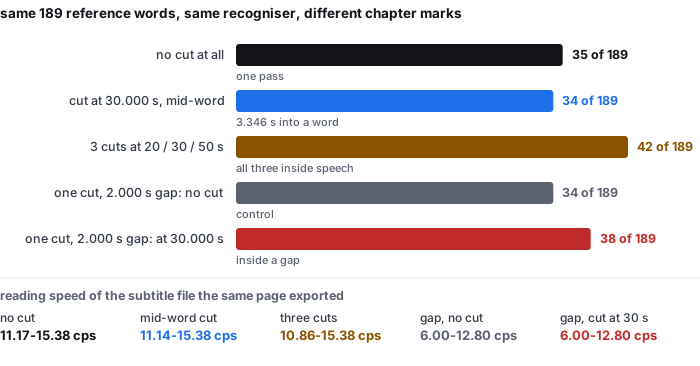
◆ The recording is 72.439 s of speech made of six public read-speech clips spliced end to end, 189 reference words, ' encoded to 24 kHz mono MP3 at 48 kbit/s (6,008.6 bytes per audio second). Each build goes through the same page in a real browser tab, one file per ' page load, and the numbers below are the page’s own TXT and its own SRT, captured from the objects it handed the browser to download — not a re-scoring of ' 'something we printed ourselves.
◆ The pair that matters is the second and the fifth row of the picture. In the first, 30.000 s lands 3.346 s inside a ' word, because the six clips are laid end to end and the fourth one spans 23.654 to 36.139 s. In the fifth the same six clips are laid with ' '2.000 s of silence between them, so 30.000 s lands in the middle of a gap. Neither mark is a worse place to cut by any rule a podcast editor ' 'would write; one costs 34 errors and the other 38, against 35 and 34 for their own uncut controls.
The five builds, row by row
| build | what the chapter mark does | audio | words | errors of 189 | SRT cues | reading speed | SRT bytes |
|---|---|---|---|---|---|---|---|
| no cut at all, one pass | — | 72.439 s | 198 | 35 (18.52%) | 27 | 11.17–15.38 cps | 1902 |
| one cut at 30.000 s, 3.346 s into a word | 30.000 | 72.487 s | 198 | 34 (17.99%) | 27 | 11.14–15.38 cps | 1903 |
| three cuts at 20.000 / 30.000 / 50.000, all mid-word | 20.000 / 30.000 / 50.000 | 72.623 s | 199 | 42 (22.22%) | 27 | 10.86–15.38 cps | 1900 |
| 2.000 s gaps, no cut | — | 84.439 s | 196 | 34 (17.99%) | 28 | 6.0–12.8 cps | 1926 |
| one cut at 30.000 s, inside a 2.000 s gap | 30.000 | 84.487 s | 200 | 38 (20.11%) | 28 | 6.0–12.8 cps | 1946 |
One file, one page load, one run each, in this order, on 2026-10-30. Errors are counted by dynamic-programming alignment against the ' 189 reference words of the six source clips, substitutions plus deletions plus insertions. The reading-speed range excludes the last cue of each file, ' 'which is a fragment cut off by end-of-audio and reads at 0.28 characters a second in every build. Cue geometry is measured on the SRT the page exported, ' ' with the wrap at 42 display-width units and a full-width character counting two — all the text here is Latin, so characters and units coincide.
Questions this page answers
Can you get a Spotify transcript for any episode?
◇ Not from the platform for every show. Spotify’s own creator documentation says “Some shows have auto-generated episode transcripts” and repeats three times that “Transcripts aren’t available to all creators or in the Spotify for Creators mobile app.” The creators who do have them can view, download, edit and re-upload a transcript; listeners can read it inside the app. ◆ The path that works on any episode you already hold the audio for is a file through a transcriber: on this site that is 30 minutes of audio and 512 MiB per job, with the model running in the browser tab and nothing uploaded.
What file does Spotify accept for a transcript upload?
◇ “Your transcript needs to be a VTT or SRT file. Max file size is 5MB. Include timestamps, otherwise your transcript won’t sync during playback.” Those three lines are the whole specification the platform publishes, and they are the only hard numbers we could find on any of the 26 pages: 2 formats, 5 MB, and a timestamp requirement. ◆ The subtitle file this page exported is 1,902 to 1,949 bytes of SRT for 72 to 84 seconds of audio, which is 0.04% of the 5 MB ceiling at that length; the ceiling is not what limits you, the audio length is.
What does Spotify count as a chapter, and what does a chapter mark do to the words?
◇ The platform’s own chapter help page gives the only numeric rule we found in the set: “You need at least 3 chapters per episode, and at least 30 seconds between each chapter’s start time.” Chapters come from the transcript, so a chapter start is an offset in the same file the transcript was made from. Of the 26 pages we could read, 0 says what happens when that offset lands inside a word. ◆ We built it both ways. With the six clips laid end to end a mark at 30.000 s falls 3.346 s into a spoken word; cutting there and rejoining gave 34 errors against 35 for the uncut file — one word, inside the ±2 word band this recogniser shows on identical input. Re-laying the same six clips with 2.000 s gaps so that 30.000 s lands in silence gave 38 against 34 for the uncut gapped file. The mark itself is free; what it does to the text is not predictable from where it sits.
Do chapter marks change the subtitle timing?
◇ 0 of the 26 pages we could read print a cue number, a cue duration or a reading speed for a chaptered episode, so nothing in the set answers this. ◆ Across the five builds the words moved and the geometry barely did: 27, 27, 27, 28 and 28 cues, every one of them a single line — the same number of rendered lines as cues, the wrap never firing a second time — and the slowest busiest cue at 15.38, 15.38, 15.38, 12.80 and 12.80 characters a second. The subtitle file came out between 1,902 and 1,949 bytes across all five, a spread of 2.5% while the word error count spread from 34 to 42.
Can Spotify transcripts be exported or downloaded?
◇ For creators, yes, as a VTT: “Click Download above the transcript to download a VTT file.” For listeners, the help page describes reading the transcript in the app and says nothing about a copy you can keep. 2 of the 26 readable pages in this set print the platform’s own numbers (the VTT/SRT rule and the 5 MB cap) and 11 of the 26 sell downloading something. ◆ From a file you hold, the export here is TXT, SRT or VTT, with the subtitle wrap at 42 display-width units a line and 2 lines a cue at most.
How accurate is a Spotify transcript?
◇ 2 of the 26 readable pages print a word error rate and 1 of the 26 gives the number of hours it was measured on: a public benchmark of 16.15 hours across 16 real podcast recordings, on one vendor’s own site. The other percentage on the pages is a marketing figure with no count behind it. ◆ Ours, on the recording this page uses: 189 reference words, the best build 33 wrong and the worst 149 — 17.46% to 78.84%, and the same page produced both. Every percentage here is quoted with its denominator because the denominator is what decides whether the number means anything on a single episode.
Is a Spotify transcript different from the captions on screen?
◇ The creator page treats one transcript as the thing that feeds everything: the app display, the VTT download, the RSS distribution toggle and the chapters. Nowhere on that page does it say the text a listener reads and the file a creator uploads are the same object, and it does say “If you upload your own transcript, it’ll be replaced if you enable auto-generated ones.” ◆ This site makes one text and one caption track from the same run: the TXT and the SRT of each build here contain the same words in the same order, and the only difference is the wrap and the timestamps.
What counts as a Spotify chapter, and what the platform will take
- ◇ Two numbers for an upload, one rule for a chapter, and nothing about the text between them. The creator documentation ' publishes VTT or SRT, 5 MB, and “Include timestamps, otherwise your transcript won’t sync during playback.” The chapter page publishes ' “You need at least 3 chapters per episode, and at least 30 seconds between each chapter’s start time.” Both pages describe an offset in the same ' 'recording. Neither says what a chapter’s start point does to the words around it, and no page in the 26 we read describes it either.
- ◇ The 5 MB ceiling is not the wall. The longest subtitle file in this batch is 1,949 bytes for 72.487 s of ' 'audio — 0.04% of the cap. At this byte rate 5 MB would hold about 89.2 hours of audio, which no podcast episode is; what ' 'actually refuses a long episode first is the transcriber’s own 30 minutes per job.
- ◇ Ninety-six seconds is the shortest legal chapter. With at least 3 chapters per episode and at least 30 ' 'seconds between start times, a chaptered episode cannot be shorter than 96 s — 3 × 32. Every build on this page is under that, so the ' 'marks here are our own stress test rather than a claim about how podcasts are cut.
- ◇ Chapters are generated from the transcript, and can be replaced by it. “Automatic chapters: A transcript of your ' 'episode is automatically generated and we choose the best chapter titles and start points”, and “If you upload your own transcript, it’ll be replaced if ' 'you enable auto-generated ones.” So the two things a creator uploads and the platform generates are the same file seen twice, which is why a mark that ' 'lands badly matters for the transcript as much as for the chapter list.
What the 26 pages behind these phrases print
- ◇ Five searches, 100 slots, 31 distinct URLs, 24 hosts. Brave, top twenty per phrase, taken 2026-10-30: ' spotify transcript, spotify podcast transcript, how to get spotify podcast transcript, spotify transcript generator, ' transcribe spotify podcast. One host — podcaststotext — holds 3 of the URLs and spotscribe holds 3. ' 26 of the 31 URLs could be read: two Reddit threads returned HTTP 403 at a Chrome user agent and again at Safari, a Spotify Community ' 'thread returned 403, the Spotify web player returns a 20-character script shell, and one page returned a 16-character challenge. ' 'Every denominator below is 26.
- ◇ Chapters are named, the boundary is not. 9 of the 26 pages mention chapters. 1 of the 26 is the ' 'platform’s own help page, which links to the chapter article without printing its rule. 4 of the 26 are product pages that sell a “chapter list ' 'with timestamps” or “chapter markers” as an output. 0 of the 26 says what a chapter start point does to the words on either side of it, and ' '0 of the 26 prints a cue count, a cue duration or a reading speed for a chaptered episode.
- ◇ The platform’s own numbers barely appear. 2 of the 26 print the 5 MB upload cap and the VTT/SRT rule: ' the Creator help page, and one blog that paraphrases it. 0 of the 26 prints the 3 chapters / 30 seconds rule. 11 of the 26 sell ' 'downloading a transcript, and 0 of the 11 says what format the download is in when the source is Spotify’s own display text rather than a new run ' 'of speech recognition.
- ◇ Two words are being sold as one page. 1 of the 26 (a Spotify transcript tool at spotscribe) is entirely about ' 'songs: 26 uses of song, 44 of lyrics, 0 of episode, and its FAQ says the tool “extracts and downloads ' 'song lyrics (transcripts) from Spotify tracks as text files”. The other 25 are about episodes: 0 of them contains the word lyrics. ' 'A reader who searches for a transcript of a song lands on the same ten results as one who wants a podcast episode, and only that one page tells them which ' 'job it does.
- ◇ Measurement vocabulary is almost absent. 2 of the 26 contain a word error rate and 1 of the 26 gives the ' 'hours behind it (16.15 hours of real podcast recordings on one vendor’s public benchmark). 0 of the 26 contains ground truth, test set, ' 'validation set or sample size. 5 of the 26 print a percentage accurate to one decimal place, which is more precision than a number without a ' 'denominator can carry.
Why a chapter mark behaves like this
◆ Cutting a recording at an arbitrary offset does three things at once, and only one of them is about words. It removes the ' acoustic context on one side of the cut, it begins the second piece with a fragment rather than a sentence, and it puts a fresh encoder frame boundary ' 'through whatever is playing at that moment. The build that gives the recogniser the cleanest fragments is not the one with the fewest cuts — it is ' 'the one whose cuts fall where the speaker had already stopped, and this recording has 3 such places (10.535, 16.072 and ' '20.655 s) plus one long tail of silence at the end.
◆ The three-cut build is the clearest signal. Two extra marks at 20.000 s and 50.000 s, both landing mid-word, ' 'took the error count from 35 to 42. The changes are not a smear of small substitutions: at the 50.000 s mark the name ' 'carker comes back as Carquill Used, and Mister John Collier gives his sitter a cheerful slap on the back comes back as ' 'Mr. John Carlier can’t see the chin of a slat in the back — eight reference words replaced by thirteen that sound right and ' 'mean nothing. A chapter that starts there is a chapter with a wrong sentence under it.
◇ The pages that sell chapter markers treat this as an editing matter. 0 of the 26 describes either the fragment or the ' 'frame boundary. ◆ What we can put a number on is smaller and more useful: a mid-word mark cost 1 word on this recording, ' 'two extra mid-word marks cost 7, and a mark inside a silence cost 4 more than its own control — which is the wrong direction from the ' 'intuition that silence is the safe place to cut.
What these numbers do not cover
- ◆ One recording, six clips, one English voice per clip. The six sources are public read-speech clips, two digitally ' 'clean and four carrying light or heavy noise, spliced into one 72.439 s file and re-encoded once to 24 kHz mono MP3. Real episodes have ' 'multiple speakers, music, room tone, compression and a second encode before anyone cuts them.
- ◆ The gapped builds have more silence than any real edit would leave. 2.000 s between clips was chosen so that a ' 'mark at 30.000 s would land inside a gap; a podcast editor who wanted a mark there would move the mark, not the audio. Those two rows exist to give ' 'the cut a control, and their absolute error counts are not comparable with the ungapped rows: the re-lay changes both the audio timeline and the word count ' '(199 and 197 words against 198).
- ◆ One run per build. The first file of each batch carries the 63 MiB model, which is cached for the rest, so the ' 'wall-clock column here (56, 38, 49, 39 and 82 s) mixes a cold run with warm ones. Timing is a single observation per ' 'row and this page draws no conclusion from it.
- ◆ Two of the eight builds we ran are not in the table. One re-lays the clips with 0.400 s gaps instead of ' '2.000 s, and both of its rows came back at 148 and 149 errors — 78.31% and 78.84% of the same 189 words — ' 'returned the last third of the speech first. That is a real failure and it is not a chapter-mark effect, so it is reported here as a boundary rather than ' 'folded into the table. The other is a 24 kbit/s copy of the mid-word build, 2.0× fewer bytes, which gave 33 errors against ' '35 — a halving of the bit rate does not buy or cost a word on this material.
- ◆ We did not run any of the 26 pages. Nothing was pasted into SpotScribe, PodcastsToText, Podtyper, Notta, ' 'Transkriptor, Castmagic, Podsqueeze, Rewind, AskSia, AnyToSpeech, Maestra, Otter, Rev, GMR, BrassTranscripts, HypeScribe or Transcript.you, and no ' 'Spotify account was used, no episode was downloaded and no creator dashboard was opened. Their numbers are quoted as claims, not reproduced.
Try it on a file you already have
The transcriber on the front page runs in the browser tab: nothing is uploaded, and the ceiling per job is 30 minutes of audio and ' 512 MiB. The first run spends about 84.5 MiB on the model and a 21.5 MiB runtime. On the recording this page measures, ' 72.439 s of audio took 56 seconds on the cold first build and 38 to 49 on the warm ones behind it. You get timestamped text wrapped ' 'at 42 display-width units a line and exported as TXT, SRT or VTT — 1,902 bytes of SRT for this recording — and there are no ' 'speaker labels, because we do not do speaker separation. If you are the publisher of the episode, the SRT is the right shape for the platform’s own ' 'upload slot: VTT or SRT, timestamps included, 0.04% of the 5 MB cap at this length.