Questions this page gets asked
How many words is a TikTok transcript?
At the 148.2 words a minute our corpus runs at: 37 words for 15 seconds, 74 for 30, 148 for a minute, 445 for three minutes, 1,482 for ten. One wrong word is therefore worth 2.70, 1.35, 0.67, 0.22 and 0.07 points respectively. None of the 14 pages in this family prints a word count at all.
Does the background music ruin a TikTok transcript?
On our test, no. Same 12.485-second clip, a music bed mixed in at seven levels: the transcript lost one word — “roast” became “rose” — and lost the same word whether the bed sat 18 dB under the voice or 12 dB over it. With no music at all the clip also came back one word wrong, a different one. The music added one word and never a second, even at four times the loudness of the speaker.
Why do these pages claim 99.9% accuracy?
Five of the 14 print a figure — 95%+, 99%, 99.9% — and none of the five says what it was measured on. On a 37-word transcript, 99.9% is 0.037 of a word: not something one clip can show. What one clip can show is 0, 1, 2 or 3 wrong words, which is 0%, 2.70%, 5.39% or 8.09%.
Can I paste a TikTok link here?
No — this page takes a file you already have. Every one of the 14 pages that rank for these two phrases takes a public TikTok URL instead, so if a link is what you need, one of them is the right tool. What we offer in exchange is that the recognition happens in your browser and the file is never uploaded. The ceiling is 30 minutes and 512 MiB per job.
Does the transcript include the words written on the screen?
No. Only the audio track is read: seven files with the same speech and different pictures produced byte-identical transcripts while ranging from 128,668 to 24,948,245 bytes, a factor of 193.9. A picture with no audio track was refused in 0.6 seconds. On a TikTok whose content is text on screen over music, an audio transcript has nothing to work with.
A 15-second TikTok is 37 words, so the accuracy moves in steps of 2.7
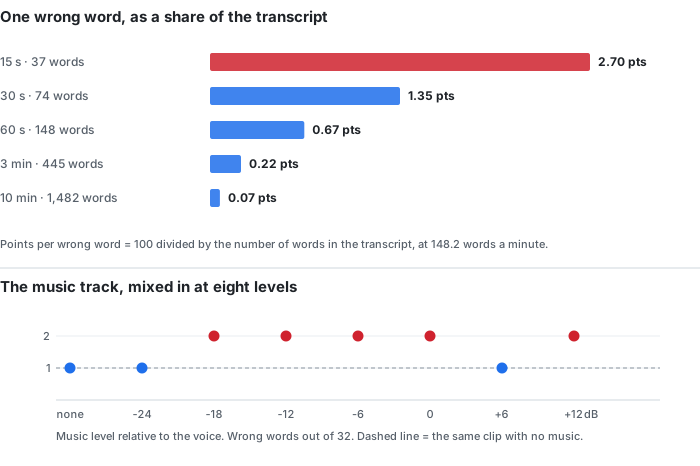
The 148.2 words a minute is not a guess. It is 229 reference words over 92.7 seconds of audio — the eight clips this site's error-rate work uses, seven of them real recorded speech and one synthetic text-to-speech. Every word count below is that rate multiplied by the length of the clip.
Then comes the part nobody prints. Accuracy on one clip is not continuous. A transcript can be wrong by 0, 1, 2 or 3 words and by nothing in between, so the number you read off a single TikTok is quantised by how long the clip is:
| clip | words at 148.2/min | one wrong word | three wrong words | what 99.9% would be |
|---|---|---|---|---|
| 15 s | 37.1 | 2.70 pts | 8.09 pts | 0.037 words |
| 30 s | 74.1 | 1.35 pts | 4.05 pts | 0.074 words |
| 60 s | 148.2 | 0.67 pts | 2.02 pts | 0.148 words |
| 3 min | 444.7 | 0.22 pts | 0.67 pts | 0.445 words |
| 10 min | 1,482.2 | 0.07 pts | 0.20 pts | 1.48 words |
The last column is the one worth staring at. A page that advertises 99.9% is claiming that on a 15-second TikTok it would get 37 of 37 words right with 0.037 of a word left over. That is not a statement about your clip; it is a statement about a corpus, and it has been pasted onto a page where the denominator is 37. The honest version of the same claim is the third column: one word wrong is 2.70 points, and that is the smallest step this clip can move.
A faster talker shifts the numbers the other way: at 200 words a minute a 15-second clip is 50 words, so one error is worth 2.00 points instead of 2.70. Faster speech does not make the transcript better, it just gives the same mistake more room to hide in.
We mixed a music bed under the same clip at eight levels
Six of the 14 pages raise the music. Not one of them says what it costs. So we built the test the cheapest way that could still be wrong in public: one clip, one variable, eight runs.
- The clip. 12.485 seconds of real recorded speech, 32 reference words, one of the eight in our corpus (light real noise, no music).
- The bed. Synthesised, not licensed: a sustained C major triad (261.63, 329.63 and 392.00 Hz) under a 70 Hz pulse every 0.5 seconds, i.e. 120 BPM.
- The levels. The bed's RMS was set relative to the voice's own RMS (−29.17 dBFS), from 24 dB below it to 12 dB above it. No file clipped; the loudest mix peaked at −1.9 dBFS.
- The run. Each file was handed to the live page in a real Chrome window, one file per page load, and the page's own output was read back. Same harness, same day, 2026-10-18.
| music vs voice | wrong words of 32 | WER | what changed |
|---|---|---|---|
| no music | 1 | 3.1% | “and” → “in” — this clip's own baseline error, nothing to do with music |
| −24 dB | 1 | 3.1% | nothing at all |
| −18 dB | 2 | 6.3% | + “roast” → “rose” |
| −12 dB | 2 | 6.3% | the same two words |
| −6 dB | 2 | 6.3% | the same two words |
| 0 dB (equal loudness) | 2 | 6.3% | the same two words |
| +6 dB | 1 | 3.1% | “roast” → “rose” only — the baseline “and” came back |
| +12 dB | 2 | 6.3% | + an inserted “a” before “rose beef” |
Read the middle rows together. From 18 dB under the voice to 6 dB over it — a 24 dB span, sixteen times the amplitude — the transcript is word for word identical, and it is one word worse than the version with no music at all. Push the bed to 12 dB over the voice, four times louder than the person talking, and you get one more error: an inserted “a”. The only word the music ever took was “roast”, and it took it at every level from −18 dB upward, including the levels where a listener would say the track is barely there.
That is not a curve, it is a step. The recogniser either hears “roast” or it does not, and once the bed is audible at all the answer stops changing. It also means the ±1 word wobble between neighbouring rows is the recogniser's own coin-flip, not the music: the “and” → “in” error appears with no music at all and disappears again at +6 dB.
One run per level, one 12.485-second clip, 32 words, a synthetic instrumental bed with no sung vocal. A trending track with lyrics occupies the same band as the voice and would very likely do worse; we did not test that, so this is a floor on the damage, not an estimate of the average.
What the 14 pages do with the music, page by page
This is the whole audit, not a summary of it. Every page below was fetched on 2026-10-18 and read in full.
| page | accuracy figure it prints | what it says about the music | a number on the music |
|---|---|---|---|
| opus.pro | 95%+ “on clear audio TikToks” | “handles multiple speakers, background music, and accents effectively” | none |
| saveto.ai | 99.9%, and “above 99%” | not mentioned | — |
| videotranscriber.ai | 99.9% | not mentioned | — |
| transcribetotext.ai | 99% | not mentioned | — |
| getthescript.app | 95%+ “on clear audio” | music-only clips come back empty | none |
| choppity.com | none | “The AI separates speech from background music and sound effects” | none |
| transcript.you | none | “loud music … will produce mistakes worth checking before you quote them” | none |
| transcript365.com | none | “Accuracy depends on … background music …” | none |
| elevenlabs.io | “#1 accuracy” over a chart with no values | “Reliable, even through music” and “reads through layered sound” | none |
Counted across all 14: six name the music as something that affects the transcript, zero of those six give it a number, five print a numeric accuracy figure, and zero of the five say what that figure was measured on — no test set, no corpus, no sample size, no error rate. And zero of 14 prints a word count, which is the number that decides whether any of the others means anything.
Three of the quotes are worth putting side by side, because they are three different answers to the same question:
- “The AI separates speech from background music and sound effects.” — choppity, a yes with no number
- “loud music, several people talking at once or heavy background noise will produce mistakes worth checking before you quote them” — transcript.you, the most honest sentence in the fourteen, still without a figure
- “Scribe beats all competing models in accuracy benchmarks” over an axis marked 100%, 75%, 50%, 25% and no values — elevenlabs, a chart that refuses to state its own result
The pattern is that the music is used as a reassurance rather than a measurement. It is the one acoustic property every TikTok has, so every page has to say something about it; what none of them does is say what it costs, which is the only form of the answer a reader can act on.
The words burned into the video are not in the transcript
This is the TikTok-specific half of the same problem, and it is measurable without touching TikTok at all. A transcript built from audio cannot see text that was never spoken, and the picture is not read.
We tested that directly, with nine files carrying the same speech: seven of them produced byte-identical output — 190 characters each, the same SHA-256 prefix 029ec35ff1c82c7e — while the files themselves ran from 128,668 bytes to 24,948,245 bytes, a factor of 193.9. The pictures ranged from 64×64 at 1 frame per second to 1920×1080 at 30. A file with a picture and no audio track was refused in 0.6 seconds; a file with a different voice track produced a different transcript, as it should.
So the practical rule for TikTok is blunt: if the joke is written on the screen and the audio is a music track, the transcript is empty or nearly so — and that is not a bug in the tool, it is the definition of the job. One of the 14 pages says this out loud: transcript.you, with “we transcribe the audio rather than reading TikTok's captions, so it works whether or not the creator added text”, and “a clip with only music will come back empty”. The other 13 do not raise it, and none of the 14 claims to read text out of the picture, because that would be a different product — optical character recognition, not speech recognition.
Twelve seconds of audio, 6.4 to 7.9 seconds of waiting
The eight runs above also timed the page, which is the other thing the family mostly answers with the word “seconds”.
- First file in a fresh browser: 36.7 s for 12.485 s of audio. That run includes fetching the model before any audio is decoded, which is why it is five to six times the rest.
- Every file after that: 6.4, 6.6, 6.9, 7.2, 7.2 and 7.9 s — about 0.51 to 0.63 seconds per second of audio.
- What that means for a TikTok: a 15-second clip is around 7.7 to 9.5 seconds of waiting once warm, a 60-second one around 31 to 38, and the 30-minute ceiling around 15 to 19 minutes. Those three are arithmetic from the measured rate, not separate measurements.
- The ceiling: 30 minutes of audio and 512 MiB per job. A ten-minute TikTok is a fifth of the time limit, so the limit is not what will stop you.
For comparison, the pages in this family that give any speed at all give 3–10 seconds (transcript365, getthescript) or “about 30 seconds for a typical short clip” (transcript.you) — the same order of magnitude as ours, and unlike ours, unattributed to a clip length.
What this page cannot do
- Take a TikTok link. There is no URL box. Download the clip, then drop the file on the front page. All 14 pages in this family do the opposite, and it is the single biggest difference between them and this one.
- Read the text on the screen. The picture is never decoded, as the 193.9× test above shows.
- Label the speakers. No cue carries a speaker tag. On a duet or a stitch there are two people and the transcript will not say which one is talking.
- Translate. The model transcribes the language it is told is spoken; it does not convert one language into another.
- Work in real time. It reads a file that already exists.
What our numbers do not cover
- One clip, one run per level. The music table is eight runs of a single 12.485-second file. It is enough to see that the effect is a step rather than a slope, and not enough to put a confidence interval on it. Every fraction here is over 32 reference words.
- The bed is synthesised. A sustained triad and a pulse, no sung vocal, no drums with content above 1 kHz, no ducking. A real trending track is harder in every one of those respects, so read the one-word result as a floor.
- The word counts are arithmetic, not measurements. 148.2 words a minute comes from our own corpus of read speech; TikTok speech is often faster, which lowers the points-per-error figures above. No clip was downloaded from TikTok and no TikTok page was scraped for this page.
- Not one of the 14 pages was run. The accuracy figures in the audit table are what the pages print, quoted; we did not upload anything to them and we are not saying their numbers are false — only that none of them states a denominator.
- One URL was unreadable. proactor.ai returned HTTP 403 to Chrome and Safari user agents and to a shell request, so it is counted as not read, and every fraction on this page is over the 14 pages we could read.
- The search volumes are printed as supplied. tiktok transcript 8,100 and tiktok video to text 110 are US monthly averages given to us; we did not measure them and we did not estimate any figure that was not given.
Try it on a clip you already have
Save the TikTok to your device, drop the file on the front page, and pick the language that is spoken. The recognition runs in your browser tab, so the file never leaves the machine. You get plain text, or timestamps, or an SRT or VTT file. What you will not get is a percentage with one decimal place on it — count the words in the result instead, and divide.