◆The short answer, before the rest of the page
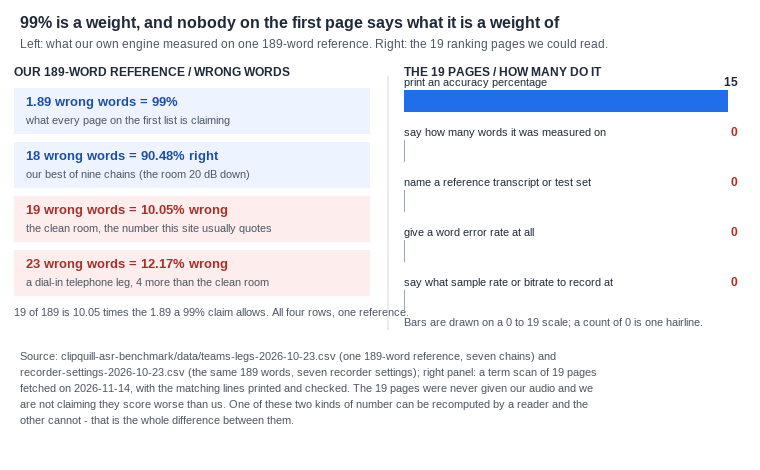
◆Academic transcription is the same recognition problem as any other, with one extra requirement: a number you can defend to a committee. The pages ranking for this phrase lead with a percentage — 15 of the 19 we could read print one, from 90%+ to 99.9% — and none of the 19 prints the word count, reference transcript or word error rate behind it, so the numbers cannot be compared with each other or checked by you.
◆We publish the opposite kind of number. On one fixed 189-word reference passage, scored by an alignment script that counts substitutions, deletions and insertions separately, our cleanest chain returned 18 wrong words (9.52%, 171 of 189 right) and the clean room returned 19 (10.05%, 170 right). A 99% claim on the same 189 words would allow 1.89: our 19 is 10.05 times that. Nine chains, one reference, every input published.
◇And the number that decides a two-person interview is not the codec. On the same passage, keeping two people on separate channels cost 143 extra wrong words and mixing them into one track cost 96, while moving the whole thing onto a dial-in telephone leg cost 4. If you take one thing from this page: how many voices are in the file matters about twenty times more than how compressed it is.
◆Fifteen pages print a percentage; not one prints what it was a percentage of
◇This is the same holes-in-the-market finding this site has reported for interview and deposition transcription, and it lands the same way on the academic word: the pages answer who types it and do not answer how good it is, in a way you can check.
◆Take the 189-word passage. 99% permits 1.89 wrong words, 99.5% 0.945 and 99.9% 0.189. On a rate card read aloud in an interview, one wrong word can change what a participant is reported to have said; on a name or a place, it can change who they are. The percentage is not a detail, but a percentage without a denominator is not a measurement, and every figure on the first page is in that state.
- ◇15 of 19 print an accuracy percentage: 360transcription 99.5, audioscribe 90%+, gmr 99, gotranscript 99.4, gradcoach “100% manual”, happyscribe 99, qualtranscribe 99, rev 99, scribie 99.9, sonix 99, transcribeme 99, transcriptionwing 99, transcriptionlive 98, vanan 99+, voxtab 99.
- ◆0 of 19 give the word count behind the figure; 0 of 19 name a reference transcript, a test set or a gold standard; 0 of 19 publish a word error rate.
- ◆0 of 19 name a sample rate, a bitrate, a codec or the word “narrowband” — of the 19 pages we read, not one of the ones quoting a percentage says what audio it applies to.
- ◇2 of 19 describe any local or on-device path (sonix “in-browser”, gradcoach “no upload”); the rest are human services, which means a transcriber you have never met receives the recording.
◆What each of the 19 readable pages actually is
Three separate searches were run on 2026-11-14 — the head phrase, the head phrase plus “service”, and the head phrase plus “research interviews” — and the merged result list was fetched page by page. Three more pages could not be read: dittotranscripts returned HTTP 403 to all three user-agent layers, eliteofficesolutions closed the connection before the first byte on every attempt, and wordibly served a JavaScript shell with 230 bytes of article text. A fourth (ticnote) is a tool page with only a nav shell, and it is counted as read because that is all there is. So every count here is over 19 pages, not 22.
| page | what kind | what it offers | accuracy claim | words it was measured on |
|---|---|---|---|---|
| transcribeme.com | human service | $0.79/min First Draft, 99%+ guarantee with a redo promise | 99% / 98% | not stated |
| acadestudio.com | human service | error-free wording throughout, no number at all | none | — |
| multilingualconnections.com | human service | the clearest treatment of which verbatim style a method needs; multi-language service | none | — |
| gmrtranscription.com | human service | $1.25 to $4.50 per minute, 99% by US-based experts | 99% | not stated |
| rev.com | human + AI | 96%+ for AI transcripts, 99%+ human-verified in 12 hours | 96% / 99% | not stated |
| sonix.ai | AI tool | browser transcription plus analysis, 35+ languages | 99% | not stated |
| ticnote.com | AI tool | a free academic-transcription tool page, shell only | none | — |
| happyscribe.com | AI + human | 99% on the human service, proofread by an expert | 99% | not stated |
| gotranscript.com | human service | 99.4%, NVivo and Atlas.ti import, .edu discount | 99.4% | not stated |
| qualtranscribe.com | human service | NDA, IRB and HIPAA framing, NVivo and ATLAS.ti formatting | 99% | not stated |
| maestra.ai | roundup | ten tools tested side by side, verbatim style compared | none | — |
| gradcoach.com | human service | “100% manual”, doctoral-qualified native speakers, $1.21/min | 100% manual | not stated |
| audioscribe.io | AI tool | 90%+ on clear audio, paid tier | 90%+ | not stated |
| transcriptionwing.com | human service | $1.29/min, “coding matrix” formatting, strict vs intelligent verbatim | 99% | not stated |
| vananservices.com | human service | $0.25 to $1.75 per audio minute, anonymisation, deletion on request | 99+% | not stated |
| 360transcription.com | human service | intelligent verbatim or any format, SSL and NDAs | 99.5% | not stated |
| voxtab.com | human service | 99% whatever the subject matter or accent | 99% | not stated |
| scribie.com | human service | $0.80/min, 99.9% at +$0.50/min for “advanced precision verbatim” | 99.9% | not stated |
| transcriptionlive.com | human service | $0.65/min, 12 to 24 hour turnaround, 99.9% on clean audio | 98% / 99.9% | not stated |
◇Two things are visible only when the column is filled in. First, the prices span 7 times — $0.65 to $4.50 per audio minute — and the accuracy column does not move with them: the cheapest page and the most expensive both say 99%. Second, the strongest number on the list, 99.9%, is the one with a surcharge attached (scribie charges +$0.50/min for “advanced precision verbatim”), which is at least an admission that the default path is not the one being described.
◆Nine ways into the same 189 words: 18 to 23 wrong, and 96 for a second voice
One recorded passage, seven audio chains a meeting or a phone can apply to it, all scored against the same 189-word reference. Wrong words are substitutions plus deletions plus insertions, computed by a separate alignment script. The wall-clock column is one observation per chain on this machine; L1 is the cold run and carries the one-time model download, which is why the simplest chain is the slowest row.
| chain | what changed | wrong / 189 | WER | seconds here |
|---|---|---|---|---|
| L1 | the same room, source decoded to PCM and nothing else | 19 | 10.05% | 310.6 (cold) |
| L2 | after a wideband meeting client's compression | 19 | 10.05% | 163.0 |
| L3 | arriving on a dial-in telephone leg (G.711 at 8 kHz, then MP3) | 23 | 12.17% | 81.8 |
| L4 | a phone on speaker: noise floor added, then a 6:1 compressor | 22 | 11.64% | 174.8 |
| L5 | the same room 20 dB down — a muted speaker or a far-field mic | 18 | 9.52% | 63.3 |
| L6 | two people at once, one per channel, kept separate | 162 | 85.71% | 63.8 |
| L7 | the same two people after the platform mixes them into one track | 115 | 60.85% | 43.8 |
◆Read the differences, not the absolute numbers. L1, L2 and L5 are within two words of each other, inside the run-to-run band this recogniser has produced on byte-identical input before, so we do not treat them as different. L3 (23) and L4 (22) are outside the band by a small margin and each has one named change attached. L6 and L7 are not near anything: the second voice in the file destroys the transcript, at 85.71% and 60.85% word error, and the summed track is the one a real meeting recording gives you.
◆An interview is two voices by definition, a focus group is six, and a viva is two people who must both be quotable. That is the whole reason to care about this table: the ranking pages quote 99% for a service where a human being decides whose turn a sentence is, and the engine-level number depends almost entirely on whether that turn-taking still exists in the file.
◆The recorder setting worth 3 words, and 8.1 seconds per minute of audio
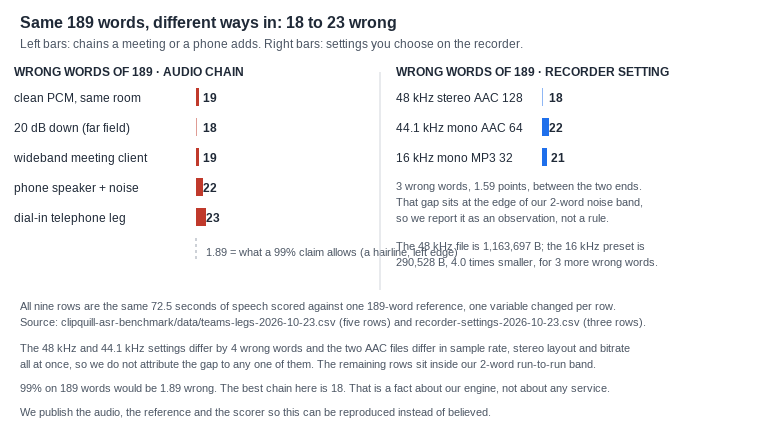
◆On the recording side the same passage was run through seven settings of the same voice. The pocket recorder's own save-space preset — 16 kHz mono MP3 at 32 kbit/s, 290,528 bytes — returned 21 wrong words (11.11%). The high-resolution setting — 48 kHz stereo AAC at 128 kbit/s, 1,163,697 bytes — returned 18 (9.52%). Three words and 1.59 percentage points, for a file 4.0 times larger.
◆That gap sits right at our two-word band, so we report it as an observation: record at 48 kHz if your device makes it easy, but do not buy hardware expecting the transcript to change much. Two settings are clearly inside the band — the same file at -26 dB with no processing (19 wrong) and the same file with automatic gain switched on (19 wrong, level restored within 0.9 dB) — which says the level matters less than the compressor you might add to fix it.
- ◆One hour of lecture: 8.1 seconds of processing per minute warm, 9.2 cold. The longest file measured was 1,610 s of audio (26.8 min) at 485.7 s warm and 550.4 s cold.
- ◆The first run costs a download: 74.0 MiB of model weights on the standard English tier, 237.5 MiB on the heavy tier, 551 MB on the maximum-accuracy tier.
- ◇0 of 19 ranking pages mention a processing rate, a file-size ceiling or a model download. They sell days of human work, so a rate is not what their buyer is comparing — but it is what makes the difference between a tool you use and a service you order.
- ◆Ceiling per job here: 30 minutes of audio and 512 MiB, so a 45-minute lecture is two jobs and a two-hour session is four. Nothing is uploaded, so there is no per-minute billing either.
◇Verbatim, intelligent verbatim, and what a qualitative analysis needs
12 of the 19 pages use the word verbatim, and five of them draw the distinction properly. multilingualconnections.com states it as a research decision rather than a preference: “If you’re working in discourse or conversation analysis, where a pause, a false start, or a filler word can carry as much meaning as the sentence itself, strict verbatim preserves all of it exactly as spoken. If you’re coding for themes or content, where readability matters more than capturing every ‘um,’ intelligent verbatim cleans up the disfluencies without losing what was actually said.” transcriptionwing.com splits the same pair into “Intelligent Verbatim (Recommended for Readability)” and “Strict Verbatim (Recommended for Behavioral Analysis)”. vanan, qualtranscribe and gradcoach each offer the choice as a setting.
◆What none of them can offer is the engine side of it. A recogniser returns tokens; it does not know which of your participant’s “ums” carry meaning and which are noise, and our own output keeps neither the filler nor the speaker. If your method is discourse analysis, the transcription is not the product you are buying — the annotator is, and 0 of the 19 pages says where its annotator sits relative to the audio once the file has arrived.
◇Who handles the recording matters more at this price point than which percentage is printed. 9 of 19 mention encryption, SOC 2, ISO 27001 or TLS somewhere on the page; 3 of 19 say when a file is deleted; 6 of 19 mention IRB or ethics approval at all, and in half of those it is a phrase in a heading rather than a data-handling commitment. For a study with named participants, that is the column to read before the accuracy column.
Questions this page answers
What accuracy can academic transcription actually deliver?
On our own material, either 89.95% or 90.48% of reference words right, depending on how the recording arrived - and those two numbers are one word apart, which is inside our run-to-run noise band. One 72.5-second passage with a 189-word reference came back with 19 wrong words through a clean PCM chain (10.05% WER, 170 of 189 reference words correct) and 18 through a chain attenuated 20 dB (9.52%, 171 of 189). A dial-in telephone leg returned 23 (12.17%) and a speakerphone with a noise floor 22 (11.64%). A 99% claim on 189 words would permit 1.89 wrong words, which is 10.05 times fewer than our clean chain produced. Those are measured numbers with a published denominator; they describe our engine only, because none of the 19 pages we read publishes the denominator of its own figure.
Why does 99% mean different things on different pages?
Because a percentage is a ratio and the pages print only the top. Nine tenths of a percent of a 30-word sample is 0.3 words; nine tenths of a percent of a 100,000-word sample is 900 words. None of the 15 pages that print a percentage states the word count behind it, so a 99% and a 99% can be 300 times apart in strictness and look identical on the screen. Our own figure is a 10.05% word error rate on a 189-word reference, and the alignment counts substitutions, deletions and insertions separately, so the arithmetic can be redone by anyone who downloads the audio and the reference.
Does the recording setting change how many words come back wrong?
In our runs, yes, but by less than the tables on the first page would suggest. On the same 72.5-second passage and the same 189-word reference, a 16 kHz mono MP3 at 32 kbit/s (the pocket recorder's own save-space preset) returned 21 wrong words (11.11%) and a 48 kHz stereo AAC at 128 kbit/s returned 18 (9.52%): 3 words and 1.59 percentage points, with the 16 kHz file 4.0 times smaller. The gap between the two is at the edge of the two-word run-to-run band this recogniser produces on identical input, so we report it as an observation rather than a rule. What is not inside the band: a telephone leg at 8 kHz costs 4 wrong words against the clean room, and the same two people mixed into one track cost 96.
What should a research interview recording actually be?
48 kHz or 44.1 kHz, mono if there is one speaker, and lossless or a high bitrate, because the thing that costs words in our data is not the bitrate but the number of people in one track. Two voices mixed into one mono track added 96 wrong words over the clean chain (60.85% WER) and 143 when they were kept on separate channels (85.71%), against 4 for a telephone codec. Record each participant on their own file where you can, even if you transcribe the mix afterwards: the separate-channel run is the number that tells you what a summed meeting recording does to a two-person interview.
Should I record each participant on a separate device?
If you can, yes - even when you plan to transcribe a mix. In our chains the same two voices kept on separate channels returned 162 wrong words out of 189 (85.71% WER) and mixed into one track returned 115 (60.85%), against 19 for the clean single-voice room. Neither arrangement is usable, but the difference between them is 47 words, and it is the difference between a summed platform recording and a per-track export. Practically: run the interview as usual and also export the platform's separate audio tracks if it has them, because the mix is the version that loses speaker boundaries permanently. No page on the first list states it as a recording instruction, only as a service they run.
Does an academic transcript need speaker labels, and do these tools give them?
A transcript that cannot attribute a quote is not a research record; multilingualconnections.com puts it as an argument, saying strict verbatim is needed when a pause or a false start carries meaning. 11 of the 19 pages we could read mention timestamps or speaker labels at all, and 6 mention NVivo, ATLAS.ti, MAXQDA or Dedoose. Our own output carries zero speaker labels: the engine returns one continuous stream of words, and separating two voices is the step we do not do. That is 0 of the 189-word reference attributed to anyone.
Is my participants' audio uploaded, and when is it deleted?
In our tool it is not uploaded at all: the recognition model runs inside the browser tab and the file never leaves the machine, so there is no server copy and no deletion schedule to quote. Of the 19 ranking pages, 3 say when a recording is removed (vanan 'secure deletion on request after delivery and approval', qualtranscribe 'deleted on your timeline', audioscribe 'not retained on our servers after processing') and the other 16 say nothing about it, so for those pages the honest answer is 'not stated here'. 2 of the 19 describe a local or on-device path; the rest are human services, where the recording necessarily reaches a transcriber who is not you.
How long does an hour of lecture take to transcribe?
On this machine, 8.1 seconds of processing per minute of audio once warm, and 9.2 seconds cold. The longest file we measured is 1,610 seconds of audio (26.8 minutes) and it took 485.7 seconds warm and 550.4 seconds cold, which is 0.30 and 0.34 times the audio length. At that rate an hour of lecture is roughly 8.1 minutes warm, before you account for the model download: the first visit in a fresh profile fetches 74.0 MiB of model weights. Nothing in these timings is in the ranking pages, which express delivery in days and hours of human work.
Can I use the output in NVivo or ATLAS.ti?
Yes, as plain text, and that is the limit. 6 of the 19 pages mention NVivo, ATLAS.ti, MAXQDA or Dedoose; transcriptionwing titles the section “Flexible Transcription Formats to Fit Your Coding Matrix” and marks intelligent verbatim “Recommended for Readability”. What none of them settles is who said which line: a thematic-coding pass needs the speaker tag to survive the import, and our export is a single string of words per cue with the speaker identity absent. Import it, quote it, but plan on adding the attribution by hand.
Where these numbers come from, and where they stop
- ◆The reference. One fixed 189-word passage used across this site’s chain measurements, scored by a separate alignment script; wrong words are substitutions plus deletions plus insertions. The 189 is the scorer’s normalised count, and it is the same reference behind every chain row on this page.
- ◆The chains.
teams-legs-2026-10-23.csvfor the seven audio chains (L1 to L7),recorder-settings-2026-10-23.csvfor the seven recorder settings (R1 to R7),timing-live-clipquill-com.csvfor the wall-clock figures,transfer-size-by-file.csvfor the model sizes. - ◆The nine sentences about codecs. Every one is a sentence in the first search page for the phrase family, run on 2026-11-14 with the user agent of a desktop browser; the page category in the table is our reading of each result, printed so you can disagree with the call.
- ◇The 19 pages. Read on 2026-11-14. Counts come from a term scan with the matching lines printed and checked by eye. A page counts once, not once per mention. Three pages could not be read at all (403, a closed connection, a 230-byte shell), so every count here is over 19, not 22.
- ◆What this does not cover. No real dissertation interview, no multi-hour recording, no professional name-anonymisation pass, no comparison with a certified human transcript, and no speaker diarization, because we do not offer it. Every chain was run once, and one- and two-word differences are reported as noise rather than as results.
- ◆Where the inputs are. The CSV files, the source audio and the scoring scripts are in the open clipquill-asr-benchmark repository, mirrored as a Hugging Face dataset and archived with a Zenodo DOI, all linked from the organisation block on this site. The error rates are ours, measured on our own audio, and are not a claim about any service named on this page.
- ◇Volume is not printed. We did not obtain a search volume for this phrase and this page states none.
Try it on your own recording
The transcriber is at the top of this page and on the front page of the site. It reads the file in your browser tab, so the lecture or the interview never leaves your machine — for a study with named participants, that is one fewer processor to write into your ethics application. Expect the first run to fetch 74.0 MiB of model weights, then about 8.1 seconds of processing per minute of audio once it is warm, and a ceiling of 30 minutes and 512 MiB per job.