Questions people actually ask about this phrase
How accurate is phone call transcription?
Accurate enough to read, not accurate enough to quote, and the number depends on what the recording contains rather than on the vendor. Fourteen of the 34 pages here print a percentage — Aircall "a minimum of 85% accuracy", Sonix 99%, GoTranscript "99%-accurate", Notta "up to 98.86%", NextPhone "85–99%", Vomo "95%+" — and none of the 34 says how many words the figure was computed over. Our own reference: two legs of one call, 49 reference words, three wrong words in strict turn-taking (6.12%). Add one pass of G.711, the codec a phone line runs, and it is still three. Let the two people talk at once and it becomes 23 of the same 49.
Should a phone call be recorded as two channels or one?
Two channels, if what you want is to keep the two voices apart — but understand what it does and does not buy. We summed the identical two-channel file down to mono and ran both. The transcript was byte-identical, all 49 words, 3 wrong, both times. What changed was the clock: 29.5 seconds for the stereo file against 6.7 for the mono file, 4.40× the wall time for text that measures the same. The two channels only turn into value if the software reads them as two channels; a page that mixes them before recognition, as ours does, is paying the stereo price for mono output.
What happens when two people talk over each other?
Both voices stop being recognisable. We started both legs at the same instant: the same 49 reference words, no new material. The one-channel file returned 33 words with 23 wrong, the two-channel file 32 words with 22 wrong — 46.94% and 44.90% against 6.12% when the same two voices took turns. Twenty and nineteen extra wrong words, and neither arrangement is meaningfully better than the other. Overlap is not a formatting problem; it destroys the signal underneath it.
Does the phone codec wreck the transcript?
Not by itself. The same turn-taking file re-encoded once through G.711 mu-law at 8 kHz and back came out with 3 wrong words, the same three, at 6.12% — identical score, a different byte count (150,812 against 602,924). That matches what our wider call-chain measurement found on 2026-10-20: eight arrangements of one recording, G.711, Opus, gain control, noise suppression, and all of them 5.43% except the full stack, which moved one word. If your audio is clean enough to be intelligible, the codec is not the part that costs you.
Which file does this page refuse?
AMR is the one we mention by name because it is what a lot of call-recorder apps export, and we do not accept it. Three of the 34 pages here name a codec at all, and Audioscribe is the one that answers the question directly — convert the AMR file to MP3 or M4A first. Our page takes MP3, WAV, M4A, MP4, WebM, OGG, AAC and FLAC up to 30 minutes and 512 MiB a job. A call that is six minutes long is one job.
Is the recording uploaded anywhere?
No. The model runs inside the browser tab and the audio is never sent to us. Most of the pages in this survey are describing a server: you hand the call over, it is transcribed somewhere else, and the transcript lands in an account. On this site there is no server to hand it to, which is also why the first run costs you a 63 MiB model download instead of an upload.
Why do the pages all promise speaker labels?
Because labels are what people ask for when they want to quote a call. Fourteen of the 34 pages advertise them and none gives a number for how often a label is right. Only two describe the mechanical alternative — Twilio's dual-channel recording page and Vonage's "split channels between agent and customer" — and we measured what that alternative does above: it earns the separation and costs the clock. Our recogniser does not separate voices at all, so the transcript is one stream of text and we say so on the page instead of selling you a label.
One call, seven arrangements, 49 words of known reference
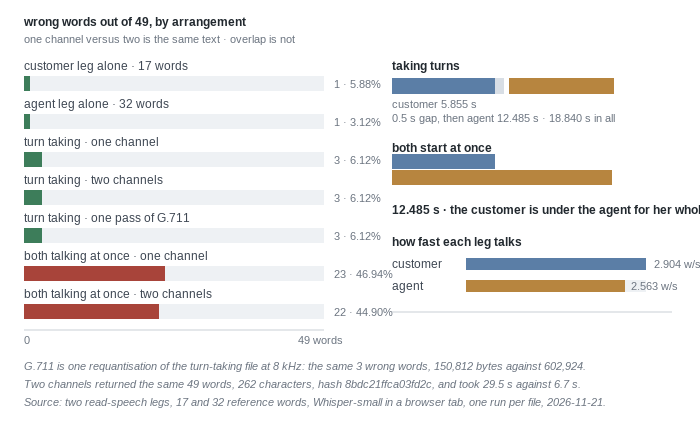
Four phrases sit behind this page — phone call transcription, transcribe phone call, call transcription and phone call to text. On 2026-11-21 they returned 38 distinct URLs, and 34 of them had a body we could read and count. The four that did not: dittotranscripts.com, turboscribe.ai and a Reddit thread returned 403 at every user-agent we tried, and salesmate.io answered 200 with no prose in it at all.
What the 34 readable pages do and do not say
- Fourteen print an accuracy percentage. None of the fourteen gives it a denominator. Aircall "a minimum of 85% accuracy", AudioType "100% accurate", GoTranscript "99.4%" and "99%-accurate", the Elephone app on Google Play "99% transcription accuracy", NextPhone "85–99%", Notta "98%" and "up to 98.86%", Quo "99%", Rev "99%+", Sonix "99%", Vomo "95%+", Noota and Withallo ("99%"). The words test set, ground truth, reference transcript, sample size and validation set appear on none of the 34. A percentage with no denominator is not a measurement; it is a promise with a decimal point.
- Two pages describe recording the two sides separately, and neither prices the trade. Twilio: "The highest accuracy call transcription solutions record each (or all) sides of the call separately… a Dual-Channel Recording solution performs better at eliminating cross-talk and cancellation noise". Vonage: "Split channels between agent and customer to easily see who said what". Both are statements about what the recording should contain; neither says what the separation costs in processing time, and neither puts a number on cross-talk to begin with. We measured both halves below.
- Seven of the 34 pages mention people talking over each other, and none of the seven puts a number on it. CloudTalk's blog lists "accuracy with accents and crosstalk: a common complaint in G2 reviews"; its product page says "background noise, crosstalk, and heavy accents reduce it"; folk says "overlapping speech makes it harder to separate speakers"; Jamie says some tools "crumble" on cross-talk; transcribe.com and GoTranscript both tell the caller to stop talking over the other person; Twilio calls dual-channel recording better "at eliminating cross-talk and cancellation noise". Every one of those seven passages is qualitative. Ours is 3 wrong words out of 49 with the turns separated and 23 with them overlapped.
- The audio is described in words and never in numbers. Sample rate, kHz, bitrate, kbit/s and dBFS appear on 0 of 34. Three pages name an audio format at all: Audioscribe and Wave each mention AMR as an accepted or refused upload type, and NextPhone's "compressed codecs, single-mic environments, variable call quality" — a sentence about why phone audio differs, with no number in it. Words per minute of speech, playable on 0 of 34. Of the 34 pages we read, the ones that sell accuracy describe the signal it is claiming accuracy on in adjectives and never in numbers.
- Twenty-two of the 34 describe sending the recording somewhere. "Upload it here", "upload your call recording", "upload the audio to a transcription service" — the call leaves the phone and the transcript lands in an account. A handful mention a local or offline path instead, and reading them one by one finds no shared design — Apple's guide is about the iPhone's own Notes app, Qualcomm's is an on-device demo, another is an offline-notes section. Whoever is holding a finished recording and would rather not hand it over is not the reader these pages are written for.
- Twenty-six of the 34 lead with speed, not with what the text is worth. "Instant", "real-time", "ready immediately after the call". One page in the set puts a ratio on it — Aircall's "you only have to wait for up to 30% of the call duration" — and three keep a phone platform and call it transcription. That is the honest shape of this result set: it is a feature list for software that carried the call, not guidance for a file on a laptop.
Counts are over the 34 pages we could fetch and read on one day, and the hits were read in context before they were counted, which is how two of them were dropped: "wideband" inside Apple's regulatory footer is a regulatory phrase, and "interruptions" on that same page is about notifications, not about people talking over each other. Where a page returned 403 or a shell we say so and leave it out of every denominator rather than guess.
How the call was built, and why the spacing is the variable
The material is two existing read-speech clips from our own benchmark, the ones with known references: C1, 5.855 seconds, 17 words, taken to be the customer, and D1, 12.485 seconds, 32 words, taken to be the agent — 49 reference words in total, and the same 49 in every arrangement below. Padded to 16 kHz mono PCM and placed end to end with a 0.5 s gap, they make an 18.840 s file that takes turns the way two people on a call usually do. Then the arrangements, one variable per pair:
| file | what it is | channels | audio | size | wrong words |
|---|---|---|---|---|---|
| legA.wav | customer leg alone | 1 | 5.855 s | 187,404 B | 1 / 17 — 5.88% |
| legB.wav | agent leg alone | 1 | 12.485 s | 399,564 B | 1 / 32 — 3.12% |
| turn-mono.wav | A then B, 0.5 s gap, one channel | 1 | 18.840 s | 602,924 B | 3 / 49 — 6.12% |
| turn-stereo.wav | the same two streams, one per channel | 2 | 18.840 s | 1,205,804 B | 3 / 49 — 6.12% |
| turn-g711.wav | turn-mono through G.711 once, 8 kHz and back | 1 | 18.840 s | 150,812 B | 3 / 49 — 6.12% |
| overlap-mono.wav | both legs start together, one channel | 1 | 12.485 s | 399,564 B | 23 / 49 — 46.94% |
| overlap-stereo.wav | the same two streams, one per channel | 2 | 12.485 s | 799,084 B | 22 / 49 — 44.90% |
The two legs are not the same length and they are not the same speed. The customer speaks 2.904 words a second, the agent 2.563; that is the whole reason "start both at once" is not the same thing as "both talking over each other evenly", and it is why the overlap file is 12.485 s long instead of 18.840. The agent's 12.485 s runs from the customer's first syllable to her last, so the customer is underneath the agent for her entire leg. The overlap rows measure exactly that: one voice buried under another for the length of the shorter leg.
Two checks decide whether any of it means anything. Stereo minus mono is a formatting difference only: adding the two channels back together reproduces the mono file sample for sample, asserted at build time (701,434 samples, both sets), so a difference in the transcript would be a difference in how the page treats channels. G.711 is a codec difference only: same 18.840 s, same speech, one lossy requantisation at 8 kHz, one byte per sample. If the codec were the thing that costs a call its words, that row would show it.
Two channels changed the clock and not the text
This is the row pair that contradicts the advice. Turn-mono and turn-stereo carry the same two voices, the same 49 reference words, the same 18.840 seconds, and once summed, the same samples. They returned the same three wrong words, and not just the same count — the same transcript, character for character, both 262 characters, both hashing to 8bdc21ffca03fd2c. Recorded as two channels, the file took 29.5 s. Recorded as one channel, 6.7 s. That is 4.40× the wall time for identical text.
That is not a bug in the recogniser, it is what mixing does. Our page sums a stereo input to mono before it hands anything to the model, which is the correct thing to do — a recogniser that gets a stereo signal has to pick something, and picking one channel loses half the call. The cost is that it pays for the summing, twice the samples decoded, and then has to un-mix two voices in the model anyway. Twilio's page says the highest-accuracy solutions record each side separately; what it does not say is that the separation only pays if the recogniser reads it as two channels, and almost no browser-side tool does.
The other side of the same coin is in the row above: one pass of G.711 changed nothing measurable. 3 wrong words before, 3 after, 6.12% both, and the errors are in the same places. If you have ever been told that a phone line makes transcription unreliable, this is the measurement to put next to it: the telephone codec, applied once at 8 kHz, cost zero words. What it does cost is a quarter of the bytes (150,812 against 602,924) and a bit of clock (10.6 s against 6.7 s) — both small next to the 4.40× that channels cost.
One run per file, seven page loads in one browser profile, in the order shown. The first run of the session carries the 63 MiB model download and its 58.8 s should not be compared with the later rows; the transcript it produced is still a transcript.
Overlap is where the words go
Put the same two voices into the same time window and the model stops hearing two people. The one-channel overlap file returned 33 words where 49 were said and got 23 of the 49 wrong — 46.94%. The two-channel file returned 32 words with 22 wrong, 44.90%. Against the 3 wrong words of the turn-taking file, that is +20 and +19 from overlapping speech alone, and the two arrangements are inside one word of each other, which is the size of the noise this recogniser produces on fixed material.
The shape of the errors is worth reading, because it is not random noise. In the turn-taking transcript the agent's line came back with one substitution — roast beef heard as “rose beef”. In the overlap transcripts the same passage reads “beef looming before us”: the roast is gone, and so is the customer's entire opening, which comes back as “The tilted clutter” in one file and “The culture” in the other. The recogniser did not mishear six words, it dropped a stretch of speech and hallucinated plausible words in its place — which is what a transcription tool does when it cannot find a boundary, and which is why a wrong-word count understates the damage.
An overlap transcript is not a rougher version of a turn-taking transcript. It is a shorter one, and the missing part does not announce itself. On the two-channel file that is 17 of 49 words absent from the output; nothing in the text says where they went.
What this measurement does not cover
- Two recorded legs, not a phone line. Both legs are read speech from a public read-speech set, one speaker each, mixed by us at 16 kHz. Nobody dialled anybody, no carrier codec ran, and the G.711 row is one requantisation applied offline with ffmpeg — a stand-in for the phone chain, not a capture of one.
- One overlap arrangement. The customer is under the agent for her whole 5.855 s. A call where two people drift in and out of each other for two minutes is a different file, and this one does not say what that costs.
- The 17-word leg is small. One wrong word on 17 reference words is 5.88%; on a 1,000-word call the same one word is 0.10%. The absolute percentages on the two single-leg rows should not be compared with the 49-word rows, and none of them should be read as a claim about your call.
- One model, one size. Whisper-small, the tier this site ships by default. The larger tiers exist on the same page and we have not run this material through them, so the overlap numbers are this model's.
- We ran none of the 34 pages. Nothing was uploaded to Twilio, Vonage, Aircall, Sonix, Rev, GoTranscript or anyone else, and no figure here measures their products. Where their copy is quoted, it is their claim about themselves, unverified.
- Timing is a single observation per row. Seven files, seven loads, one profile. The clock numbers are what one machine did on one morning, and the 6.7 s mono run is fast enough that a warmer or a busier machine could move it by seconds. The text does not move; the clock does.
Try it on a call you already recorded
The transcriber is at the top of this page. It takes the file you already have — MP3, WAV, M4A, MP4, WebM, OGG, AAC or FLAC, up to 30 minutes of audio and 512 MiB per job — and the model runs inside your browser tab, so the recording is not uploaded. Expect the first run to spend about 63 MiB on the model. You get timestamped text out as TXT, SRT or VTT, and the SRT files recaptured from this domain on 21 November never emit a line wider than 42 display-width units. We recaptured the SRT output from this domain on 21 November across eight recordings and measured every text line in it; the widest measured exactly 42. There are no speaker labels. On this page's material, a recording of two people who did not talk over each other came back with 3 wrong words out of 49, and a recording of the same two people talking at once came back with 23 — so if you have a choice about how the call is recorded, that is the number to weigh.