The first page for this word is not a tool list
Every other word in this family returns a list of products. This one returns a reading list. That is not a detail — it tells you what the person typing this phrase is actually doing. They are not comparing upload buttons. They are trying to find out what the document is supposed to be before they make one.
And the guides that answer that question all stop at the same place. They explain that there are four conventions, they say the choice has to be made before you start recording, and then they hand you a tool list in which no tool says which of the four it implements.
- Ten results, nine domains. Search taken 2026-10-15. reddit.com appears twice, with two separate r/PhD threads.
- 4 of 10 are not a product. A university library research guide, an independent marketing blog, and two forum threads. 2 more are guides published by vendors. Only 4 of 10 are product pages.
- 7 of 10 read. Both reddit threads and turboscribe.ai returned HTTP 403 to three user-agent layers each, so every count below is over the seven pages we could read.
Search results are the first page returned on 2026-10-15. Nothing here is a traffic estimate: we did not look up, and do not print, any search volume for this phrase.
What each of the ten results actually is
This is the table that makes the shape of the page visible, and no page on it prints this table.
| result | what kind of page | what it is offering |
|---|---|---|
| maxqda.com | product | a qualitative-analysis suite whose page is half software tour and half method guide |
| sonix.ai | vendor guide | a tool comparison written for witness statements, not interviews |
| get.otter.ai | product | a landing page: convert recordings into “searchable and editable interactive transcripts” |
| memories.ai | product | hiring-side transcription: speaker labels, AI summaries, search across past interviews |
| guides.library.harvard.edu | not a product | a university library guide listing software, pedals and loaner equipment; it recommends running Whisper on your own device for sensitive recordings |
| bredemarket.com | not a product | a marketing blog asking what you do with a transcript once you have one |
| reddit.com/r/PhD | not a product | “Transcribing your Interview Data” — not read (403) |
| looppanel.com | vendor guide | a tool comparison written for UX research, and the only page that gives the four conventions as a list of four |
| turboscribe.ai | product | a free-transcription page — not read (403) |
| reddit.com/r/PhD | not a product | “Best transcription software for qualitative interviews??” — not read (403) |
Count the columns, because this is the first word in this family where the top of the page is mostly not commercial. Four of the ten results have nothing to sell you, and two of the four product-and-guide pages that do are written by the vendors they recommend. That is a page built for someone who is deciding what the document should be, and the decision they are making is the one below.
Four conventions, and the one thing none of the seven says
The four names are the professional standard and two of the seven readable pages state them properly. Here they are, with the words those pages use, so you can see the disagreement is real:
| convention | what it keeps | what it drops |
|---|---|---|
| verbatim | every word and sound: filler words, repeated words, stuttering, non-verbal nods, laughter | nothing |
| intelligent verbatim | the speaker's intended meaning, in their own words | filler words, false starts, repetitions, “non-standard words (such as ‘dunno’)”, off-topic utterances, pauses, coughing |
| edited | the content, in correct grammar | grammatical mistakes, incomplete sentences — and, as MAXQDA's FAQ itself warns, the interviewee's voice may be changed |
| phonetic | how the words were pronounced, in phonetic symbols | ordinary spelling |
Now the count that matters. Three of the seven readable pages use the word verbatim at all. Two of the seven give the full four-way taxonomy. Zero of the seven says which of the four its own engine produces.
The nearest thing to an exception makes the point rather than breaking it. The Sonix guide states that the tools it recommends produce “verbatim output by default” — but that page is about court-bound witness statements, where the convention is not the buyer's choice at all; it is a rule of evidence. It is the only page of the seven that names a convention for an engine, and it names it for a different job.
Taxonomy quotes are the pages' own short phrases, taken from the plain-text extraction of each page on 2026-10-15. The four-way list appears on maxqda.com and looppanel.com; the word verbatim also appears on sonix.ai. Counts are over the seven pages we could read, not the ten results.
So what convention does an automatic engine produce? Here is ours, measured
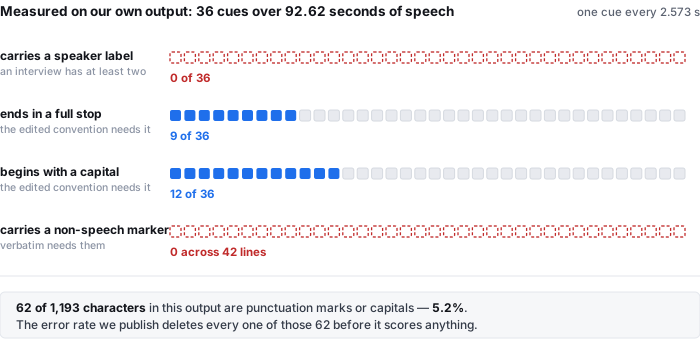
No page will tell you, so we measured our own output instead of describing it. Eight clips of real speech, run through the deployed site, 36 cues over 92.62 seconds — and every number below is a count of what came back, not an adjective.
| what the transcript has to carry | measured on our output | which convention needs it |
|---|---|---|
| who spoke | 0 of 36 cues carry a speaker label | all four — an interview has at least two people |
| what was not words | 0 bracketed markers across 42 lines | verbatim |
| a full stop at the end of the cue | 9 of 36 | edited |
| a capital letter at the start of the cue | 12 of 36 | edited |
| punctuation and capitals, in total | 62 of 1,193 characters — 5.2% | edited |
Read the last three rows together and the shape is obvious: the output is edited-shaped — it is punctuated and capitalised — but the formatting is partial, not systematic. Two thirds of the cues begin with a lower-case letter and three quarters of them never reach a full stop. A reader who needs the edited convention cannot rely on the text to tell them where sentences are, and a reader who needs the verbatim convention gets neither of the two things that convention exists to preserve.
The numbers that go with that, for the interviews people actually run:
- One cue every 2.573 seconds. 36 cues over 92.62 seconds. A 45-minute interview arrives as roughly 1,049 separate cues; a 60-minute one as roughly 1,399 — and every one of them unattributed, because 0 of 36 carry a speaker label.
- 6.22 words per cue — 224 words across the 36 cues. That is the size of the unit you have to rejoin if you want sentences back.
- 42 lines for 36 cues. Six cues need a second line; the longest line is 42 display-width units, where a full-width character counts as two, so one rule covers thirty languages.
- 148.2 words a minute (229 reference words over 92.7 seconds), so 45 minutes of speech is about 6,670 words of transcript and 60 minutes about 8,893.
All of the above is measured on the deployed site's own output, re-fetched from the live page rather than a local build: 36 cues / 42 lines / 6 two-line cues / longest line 42 units. Character and cue counts were taken with a script over the returned SRT files. The two audio lengths differ on purpose — 92.7 s is the sum of the eight clips' decoded durations and is what the word rate is computed from, 92.62 s is where the last cue ends.
The accuracy number cannot answer this question, including ours
Every page on the first page that prints a number prints a percentage, and the percentages are about words. Zero of the seven readable pages names a test set, a corpus, a validation set, ground truth, a sample size, or a word error rate. Two of the seven print any percentage at all, and both of those are a target or a vendor claim rather than a measurement.
Ours is a measurement, and it still cannot answer the convention question. Our published error rate is computed after lower-casing the text and replacing every non-letter and non-digit character with a space. That is a defensible choice for comparing transcripts to a reference — and it means 62 of the 1,193 characters in our own output, the punctuation marks and the capital letters, are deleted before the score is taken. A transcript can be in the wrong convention and its accuracy figure will not move.
| condition | reference words | base tier |
|---|---|---|
| typical clean and light real speech | 85 | 7.1% |
| all eight clips, weighted | 229 | 20.1% |
| telephone band with echo and hiss | 22 | 22.7% — 3.2× the typical group |
| heavy background noise | 89 | 34.8% — 4.9× the typical group |
| worst single clip | 71 | 40.8% |
The telephone-band row is the one an interview researcher should read twice: an interview conducted over a phone line or a video call is exactly that condition, and on our own material it costs 3.2 times the error rate of clean speech.
And when the text is wrong, it is wrong in two different ways, which is the distinction the four conventions are about. On all eight clips, our default tier produced 4 missing words and 34 substituted ones — substitutions are 89.5% of its 38 errors. The smallest local tier missed 1 word and substituted 20; the paid cloud reference missed 7 and substituted 22, so it drops more words than the smallest model on this machine. Nothing in the returned text marks which kind of error you are looking at: a dropped word and a wrong word both arrive as a word that is not what was said.
Error rates from wer-by-condition.csv and wer-by-sample.csv; the missing/substituted split is the ALL row of edit-load-8-clips.csv; the normalization rule is documented in data/README.md. All in the public benchmark repository. These are our numbers on our audio; we uploaded nothing to any of the seven pages and did not run them.
Questions people actually ask about this word
What are the four types of interview transcription?
Verbatim, intelligent verbatim, edited, and phonetic - and the distinction is about how much of the recording is written down, not about how accurate the writing is. Two of the seven readable pages on Google's first page for this phrase lay the four out explicitly. MAXQDA's own FAQ defines a strict verbatim transcript as including "every word and sound that was recorded, including filler words, repeated words, stuttering and stammering, non-verbal nods", an intelligent verbatim transcript as the more readable form that excludes "filler words, non-standard words (such as ‘dunno’), repeated words and sentences", an edited transcript as one where the researcher "corrects grammatical mistakes, and incomplete sentences", and a phonetic transcript as one that "includes notes on how the spoken words are pronounced using special phonetic symbols". Looppanel uses the same four names, adds that intelligent verbatim is "also known as clean verbatim", and notes that the second type "removes filler words and false starts". Three of the seven pages use the word verbatim at all; zero of the seven says which of the four its own engine produces.
Which of the four does an automatic transcription tool produce?
Not one of the seven readable pages says, and that is the whole problem with this word. We can only answer for our own engine, so we measured it rather than describing it. Across eight clips - 36 cues over 92.62 seconds of speech, 224 words - the output is punctuated and capitalised, which makes it look like the edited convention, but the formatting is partial rather than systematic: only 9 of the 36 cues end in a full stop and only 12 of the 36 begin with a capital letter. It carries zero speaker labels and zero bracketed non-speech markers, which is what a verbatim convention requires and what an interview needs most. So the honest answer is that our output is an edited-shaped transcript with the speaker identity stripped out, and nothing on our page used to say so until this one did.
Does an interview transcript need speaker labels, and do automatic tools provide them?
An interview has at least two people in it, so a transcript without speaker attribution is not a record of the interview - it is a record of the audio. Three of the seven readable pages claim speaker labels or diarization as a feature (Sonix, memories.ai and Looppanel), and exactly one of the seven gives a number for how often it goes wrong: the Sonix guide cites speaker diarization error rates "of 10 to 19%" as "common on multi-party recordings even in leading open-source systems", attributing that to Pyannote 3.1 benchmarks - not to its own tool. Our own output, measured on the deployed site, carries a speaker label on 0 of 36 cues. We do not offer speaker separation at all, and the number that goes with that is simply zero out of thirty-six.
Why does punctuation matter in an interview transcript, and does accuracy measure it?
It matters because the four conventions disagree about it: an edited transcript is defined by corrected grammar and sentence structure, a verbatim one by keeping what was actually said. And the accuracy number everybody quotes cannot tell you which one you received. Zero of the seven readable pages contains the word punctuation in any form, and zero mentions capitalisation or case. Our own published error rate is computed after lower-casing the text and replacing every non-letter and non-digit character with a space, so of the 1,193 characters in our output, 33 punctuation marks and 29 capital letters - 62 characters, 5.2% - are deleted before the score is taken. A transcript can be in the wrong convention and its accuracy figure will not move.
How long does a 45-minute interview take, and how much text comes back?
Two numbers, both from our own measurements. Text: our reference material runs at 148.2 words a minute (229 reference words over 92.7 seconds), so 45 minutes of speech is about 6,670 words of transcript and 60 minutes is about 8,893. Time: at 18.1 to 20.5 seconds of processing per minute of audio at steady state, 45 minutes is 815 to 923 seconds. Structure: our output runs at one cue every 2.573 seconds, so a 45-minute interview arrives as roughly 1,049 separate cues and a 60-minute one as roughly 1,399 - every one of them unattributed, because none of them carries a speaker label. The ceiling on this site is 30 minutes of audio and 512 MiB per job, so a 45-minute interview is two jobs.
What our numbers do not cover
- Our corpus contains no interviews. Eight clips, two speakers, one noise type, and six of the eight are read speech. There is no conversation, no overlapping speech and no back-channel anywhere in it. The convention question is precisely the question this corpus cannot measure, which is the point of the page rather than a gap in it.
- We did not test speaker separation, because we do not offer it. The 0 of 36 speaker labels is a count of our own output, not a measurement of how hard diarization is.
- The error rates are ours, measured on our own audio. They are not a claim about any service named on this page.
- The classification of the ten results is a reading of one search page on one day. We have quoted the lines we classified on so you can disagree with the call.
- Three of the ten pages could not be read at all — both forum threads and one product page returned HTTP 403 to every user-agent layer we tried — so every count is over seven pages, not ten.
- Search volume is not stated, on purpose. We did not obtain a figure for this phrase and we do not print one.
Try it on your own audio
The transcriber is on the front page of this site. It reads the file in your browser tab, which means the audio never leaves your machine — and the ceiling is 30 minutes of audio and 512 MiB per job, so a 45-minute interview is two jobs. Expect the first run to spend about 78.4 MiB on the model download and roughly a gigabyte of RAM, then 18–20.5 seconds of processing per minute of audio once it is warm. What you get back is timestamped text that wraps at 42 display-width units a line, in the convention described above — and now you know which one that is.