Questions this page answers
On this page ◆ marks a number measured here — on our own recordings, in a real browser tab — and ◈ marks a count read off the twenty pages that rank for this phrase. Both name the row or the page they came from.
How do I turn a voice memo into text?
◆ An iPhone memo is already a readable file: open it on the phone, or drop it into a transcriber.
The extension is .m4a, which names an MPEG-4 container holding an AAC stream — the box, not the codec inside it. Nothing has to become an MP3 first, and converting it does nothing for the words: on our own 72.5-second recording the same speech at 32, 64 and 192 kbit/s produced 21, 22 and 18 wrong words out of 189 — 11.11%, 11.64%, 9.52%, with the largest file 4.01× the smallest for a 3-word difference.
◈ Four of the twenty pages name M4A and AAC side by side as accepted formats, and none of the twenty says which of the two is the container.
Why does my iPhone Voice Memos transcript button not appear?
◈ Two requirements must both be met, and the ranking pages cannot agree on the second. Apple’s own guide says transcription is available on iPhone 12 or later, in English, Spanish, Portuguese, Italian, French, German, Japanese, Korean, Simplified and Traditional Chinese, and not in every country.
◈ Nine of the twenty repeat the iPhone 12 floor, including both country versions of that Apple page. The software half splits: five pages name iOS 18, one names iOS 17.4, one gives the hardware floor with no version at all, and one quotes a third-party app’s own iPhone 13 with iOS 16.
◆ Reading those five in the order search returned them, the version number goes backwards twice.
What does my upload limit actually mean in minutes?
◆ A byte ceiling and a minute cap are the same limit written twice, and the conversion needs a bitrate. At 64 kbit/s — the rate at which one page’s own 100 MB and 5 min figures reconcile — a 5-minute memo is 2,400,000 bytes and 100 MB holds 208.3 minutes.
◆ The minute cap therefore bites 41.7× before the byte cap, a fact that page never states. The same rate turns 5 MB into 10.4 minutes and 50 MB into 104.2 minutes.
◈ Six of the twenty pages print a byte ceiling and a minute figure, and zero converts either into the other.
◆ Our own caps are 30 minutes and 512 MiB; a 30-minute memo at 64 kbit/s is 14.40 MB against a 512 MB ceiling, so the minutes cap arrives 35.6× before the bytes do.
How many words does a voice memo hold?
◆ At the rate measured across our own eight reference clips — 229 words in 92.70 seconds, 2.4703 words a second, 148.2 words a minute — one minute holds about 148 words, five minutes about 741, twelve about 1,779, thirty about 4,447. A 45-second memo is 111.2 words: a paragraph, not a document.
◆ This is the conversion that makes an error count readable — 18 wrong words only means something once you know the reference is 189, which makes it 9.52%.
◈ Zero of the twenty pages gives a words-per-minute figure for speech, so none of their accuracy claims can be turned into a number of words.
Does the .m4a from my phone need converting before transcription?
◆ No, and the conversion that looks tempting is the one that changes nothing. The sub-question is whether the AAC stream is boxed (which is what an .m4a is) or written as bare ADTS frames. We measured both from the same 12 seconds.
◆ The MP4-boxed file is 102,896 bytes, the ADTS file 102,637, a 259-byte gap, and the 189 frame headers account for 1,323 bytes, 1.29% of the raw stream. Decoded duration moves by 0.096 s and the first sound lands 64 ms later, while the transcript stays 5 cues and 265 bytes in both — and a repeat run reproduced it byte for byte.
◈ Zero of the twenty pages discusses the framing question at all.
Is a voice memo transcribed locally or uploaded?
◈ It depends on the page, and most leave it implicit. Fifteen of the twenty describe an upload step, and one says outright what happens after it: “Your file is sent for transcription and is not retained on our servers.” Ten mention on-device processing, but most of those mean the phone’s own transcript rather than a website. The plainest sentence in the set separates the two halves in one FAQ answer, placing Apple’s built-in transcription on-device and its own tool on cloud models by default.
◆ On this site the recognizer runs in the tab: 74.0 MiB of model comes down the wire and the memo goes nowhere.
4.01× the bytes bought 1.59 points — and 1.59 points is three words
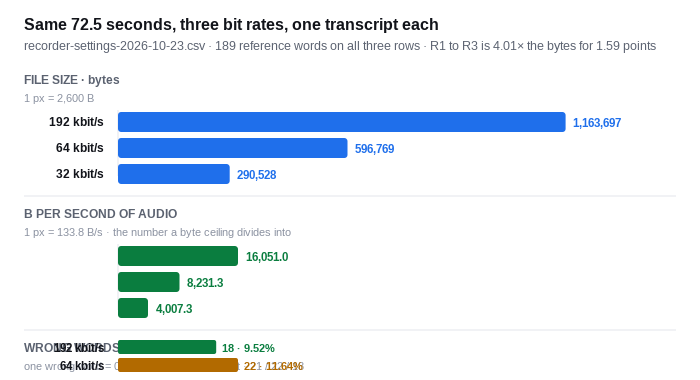
◆ One recording, encoded three ways, read by the same recognizer. The duration and the reference text are identical in all three rows, so the only variable is the encoder.
- 32 kbit/s — 290,528 bytes, 4,007.3 bytes a second. 21 wrong words, 11.11%. That file is 12.0× smaller than the uncompressed master it was cut from.
- 64 kbit/s — 596,769 bytes, 8,231.3 bytes a second. 22 wrong words, 11.64%. Twice the bit rate of the row above and one more wrong word. This is the row that settles the question the page asks.
- 192 kbit/s — 1,163,697 bytes, 16,051.0 bytes a second. 18 wrong words, 9.52%. The best of the three, 1.8 points better than the cheapest.
◆ The full spread is 1.59 points, and on 189 words one word is worth 0.53 of a point, so the spread is three words. Our own repeat runs on this material move by up to ±2 words: one word outside the wobble. That is why this page attaches the number instead of calling the 192 kbit/s row “more accurate”.
The unit that decides whether your memo fits is not the one the pages print

◆ Measured against the setting the encoder was given, these three files came out at 100.2%, 102.9% and 100.3% of nominal — over by 7.3, 231.3 and 51.0 bytes a second. That is normal: frame headers, padding and the container add a little. The consequence is that the number to divide into a byte ceiling is bytes per second of audio, and that number is on none of the twenty pages.
| encoder setting | nominal B/s | measured B/s | measured / nominal | file for 72.5 s |
|---|---|---|---|---|
| 32 kbit/s | 4,000 | 4,007.3 | 100.2% | 290,528 B |
| 64 kbit/s | 8,000 | 8,231.3 | 102.9% | 596,769 B |
| 192 kbit/s | 16,000 | 16,051.0 | 100.3% | 1,163,697 B |
- ◈ Zero of the twenty pages gives bytes per second for a memo. The nearest is one page describing its own demo file as “mono 24 kHz at 48 kbps (307 KB)” over 51.1 s — that is 6,008 B/s, but offered as a note about one file rather than a rule a reader can apply.
- ◆ Megabytes are not comparable across encoders. The same 72.5 seconds is 290,528 B at one setting and 1,163,697 B at another, so “5 MB” names a duration only once you know the rate behind it.
- ◈ Seven of the twenty print a megabyte figure, and the four that print it as their own upload ceiling — 100 MB, 1 GB, 5 GB, 5 MB — print no rate beside it.
- ◆ The model download is the biggest file in the job. The recognizer comes down as 74.0 MiB on the wire, 78.4 MiB on a first visit with the extra assets — 82.2 MB in the same decimal units the memo is measured in — against a 5-minute 64 kbit/s memo of 2.47 MB. The download is 33.3× the memo it is about to read.
Rates are file size divided by audio seconds, from recorder-settings-2026-10-23.csv. The 12.0× figure in the panel above compares the 290,528 B file with the 3,480,078 B uncompressed master in the same CSV. Nominal B/s is the setting divided by eight.
The two numbers on an upload strip are not the same limit
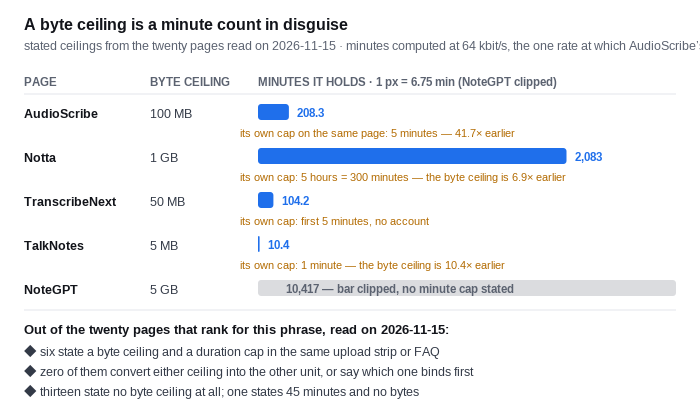
◆ A memo is a small file, so the byte ceiling almost never stops you. The minute cap does, and the two are printed side by side often enough that the missing division is worth doing.
- 100 MB beside 5 minutes. ◆ At 64 kbit/s a 5-minute memo is 2,400,000 bytes, 2.4% of a 100,000,000-byte ceiling. Reaching 100 MB would take 208.3 minutes of recording. The minutes bind, by 41.7×, and the page never says so.
- 5 MB beside 1 minute. ◆ 5 MB holds 10.4 minutes at the same rate, so the minute cap bites 10.4× first. A 1 GB ceiling beside a 5-hour cap goes the other way: 1 GB holds 2,083 minutes, so there the bytes bind first, 6.9× before the hours run out.
- ◈ None of the six prints the bitrate its pair assumes, so the pair only reconciles once you pick a rate for it. The rate that makes the first pair consistent is 64 kbit/s — the telephone standard, not the rate a phone records a memo at.
Ceilings are quoted as printed on 2026-11-15. Minutes are computed here: bytes × 8 ÷ 64,000 ÷ 60, MB taken as 106 and GB as 109. None of the six was uploaded to, so nothing here describes how they enforce a limit.
What the twenty pages say, one column at a time
◈ Twenty of the twenty-two URLs we collected put a body in front of us; two did not. The columns below are the ones this phrase keeps failing on. “not read” means we could not get the page, not that it is silent.
| page | names a bitrate | byte ceiling | names a duration | accuracy number | iPhone floor |
|---|---|---|---|---|---|
| audioscribe (tool) | no | 100 MB | 5 min | none | not stated |
| audioscribe (guide) | no | none | 5 min free / 25 min with account | none | iPhone 12 |
| notta | no | 1 GB | 5 h, 3 min on the free tier | none | not stated |
| descript | no | none | none | none | not stated |
| apple support (US) | no | none | none | none | iPhone 12 |
| apple support (CA) | no | none | none | none | iPhone 12 |
| reddit r/iphone | not read — HTTP 403 on every user agent we sent; excluded from all counts | ||||
| notegpt | no | 5 GB | none | none | not stated |
| voicetonotes | no | none | none | none | not stated |
| talknotes | no | 5 MB | 1 min | “100% free”, no accuracy | not stated |
| maestra | no | none | none | none | not stated |
| dittotranscripts | not read — HTTP 403 on every user agent we sent; excluded from all counts | ||||
| plaud | no | 64 GB device drive | none | ~98% | not stated |
| spokenly | no | none | “over 30 minutes” as a case | none | iPhone 12 |
| geodeclarity | no | none | none | none | iPhone 13, its own app |
| transkriptor | no | none | none | up to 99% | iPhone 12 |
| voice-notes | no | 50–100 MB language pack | none | 95%+ / 80–90% | iPhone 12, iOS 17.4 |
| riverside | 48 kHz only | none | none | up to 99% | not stated |
| transcribenext | 320 / 96 / 48 kbit/s | 50 MB free | 5 min free | quotes 96% | iPhone 12 |
| voicebraindump | no | none | none | none | iPhone 12 |
| idownloadblog | no | none | none | none | not stated |
| flexclip | no | none | none | up to 95% | not stated |
- ◈ One page names a bitrate, and it names three because it ran the comparison itself: the same 51-second memo at 320, 96 and 48 kbit/s, of which “9 of 12 segments came back identical”. That is the closest any page in this result set comes to the question above — and its own framing is careful about what it is not: “Re-encoding does not add a predictable error — it re-rolls the dice on the ambiguous passage.”
- ◈ Six pages print an accuracy percentage; none prints a denominator. The numbers run from “95%+ for clear speech” to “up to 99%”, and none of them sits within a paragraph of a reference transcript, a test set, or the words word error rate.
- ◈ Nine pages give an iPhone floor; the software half of it splits three ways. Five say iOS 18, one says iOS 17.4, one gives the hardware floor with no version, and one describes a third-party app’s own iOS 16 requirement.
- ◆ A reader who checked two of these pages has even odds of a different answer than one who checked two others.
- ◈ Thirteen state no byte ceiling — the limit least likely to matter for a memo, and the one most often left off.
Counts run over the 20 pages whose body we could read on 2026-11-15. The searches were voice memo to text, voice memo to text iphone, transcribe voice memo and iphone voice memo to text, de-duplicated to 22 URLs across 20 domains. Reddit and dittotranscripts returned HTTP 403 to all three user agents we tried and are excluded rather than counted as zero.
An .m4a and an .aac hold the same audio, and the transcript proves it
◆ The file off an iPhone and a file an encoder calls .aac are the same AAC stream in two framings. That looks like a conversion worth making before uploading, so we measured what it changes on 12.000 seconds of audio.
| filing | bytes | frames | decoded | first sound | cues | text |
|---|---|---|---|---|---|---|
| MP4 box (.m4a) | 102,896 | 189 | 12.000 s | 0.5611 s | 5 | 265 B |
| raw ADTS (.aac) | 102,637 | 189 | 12.096 s | 0.6251 s | 5 | 265 B |
| raw ADTS, second run | 102,637 | 189 | 12.096 s | 0.6251 s | 5 | 265 B |
- ◆ 259 bytes apart, all of it bookkeeping. The payload is 101,314 bytes in both. The difference is framing: 189 ADTS headers of 7 bytes is 1,323 bytes, 1.29% of the raw stream, against the MP4 box’s own overhead.
- ◆ The clock moves and the words do not. The raw stream decodes 0.096 s longer and first sound lands 64 ms later; the transcript is 5 cues and 265 bytes either way, and the repeat run reproduced the first byte for byte.
- ◆ So “convert to .aac first” is not advice. The audio handed to the recognizer is the same audio, sample for sample — the only thing removed is a container the browser parses anyway.
Rows are aac-adts-framing-2026-10-26.csv. The 64 ms offset is the decode table’s first-sound field, not a reading of the transcript.
What an iPhone memo is, and what it costs to read
◆ The extension settles the format question: .m4a is an MPEG-4 container whose audio track is AAC. A browser decodes that in the tab — on our decode matrix the .m4a and .mp4 rows differ by 20 bytes, the same box with a video track added to one. What is worth knowing is the cost of reading one, because a memo is short and the fixed costs are not.
- ◆ The download dwarfs the memo. 78.4 MiB on a first visit, 74.0 MiB steady-state, against a 5-minute 64 kbit/s memo of 2.47 MB — 33.3× in like units.
- ◆ Short files do not reach the steady-state rate. Four measured points: 13 s of audio took 45.2 s cold, 23.5 s warm; 60 s took 38.9 / 24.9 s; 277 s took 98.9 / 105.2 s; 1,610 s took 550.4 / 485.7 s. In seconds per minute of audio that is 208.62, 38.90, 21.42, 20.51 cold. The first two are the fixed cost, not the recognition.
- ◆ Memory does not track length. Peak memory at those four lengths, page heap and process: 1,128 / 821 MB, 919 / 823 MB, 969 / 921 MB, 977 / 999 MB. A 27-minute memo used no more RAM than a 13-second one.
- ◆ The caps, in the order they bind. 30 minutes of audio or 512 MiB per file, checked before work starts. A 30-minute memo at 64 kbit/s is 14.40 MB inside a 512 MB ceiling, so the minute cap arrives 35.6× before the byte cap — the same asymmetry the pages above never state, on this side of the fence as well.
Decode figures are the .m4a and .mp4 rows of container-codec-matrix.csv. Timings and memory are four runs of this site’s own transcriber on this machine; the 13-second run includes the cold download. No line was fitted through the four timing points, because the cost per minute falls from 208.62 to 20.51 across them and a single slope would be a fiction.
Where these numbers come from, and where they stop
◈ Every figure above is either a counted fact about the twenty pages read on 2026-11-15 or a row from the public benchmark repository. None of it is a guess about what a competitor does behind its own interface.
- Raw data and the measurement scripts — github.com/supersophia8888-cloud/clipquill-asr-benchmark, including the recognizer’s raw text behind every error count, so the scoring can be redone under different rules.
- Archived copy with a DOI — 10.5281/zenodo.22826968, the concept DOI: that link always resolves to the newest version of this dataset, all versions.
- The same data as a dataset — huggingface.co/datasets/sophia8888/clipquill-asr-benchmark
- The bitrate ladder — recorder-settings-2026-10-23.csv, seven settings on one 72.500 s recording and 189 reference words.
- The framing comparison — aac-adts-framing-2026-10-26.csv, three rows: the box, the raw stream, and a repeat of the raw stream.
- What a memo recorded on a phone looks like against the rest — seven ways to store the same 72.5 seconds, and only the noise reduction button costs words
- The extension that is the same box with a video track — .m4a and .mp4 are twenty bytes apart
- A message the phone network has already shaped — the network gets to the audio first
- The same question asked about every audio file — one word covers three kinds of file
Where this page stops: the ladder is one recording, 72.5 seconds of English, not a sample of memos, so it says what the encoder does and not what your memo will score; the iPhone thresholds are what the pages print and we tested none of them on a device; the twenty-page counts are one result set on one day. No file was uploaded to any of the twenty pages.
Run it on your own voice memo
◆ Drop the .m4a in. The model is downloaded into the tab and the file is decoded there, so there is no conversion step and no upload: .m4a, .aac and .mp3 all reach the recognizer as the same kind of samples. Expect a first run to spend about 78.4 MiB and roughly a gigabyte of RAM, and expect a short memo to feel slower than its length suggests — the fixed cost is the download, not the words.
◆ The caps are 30 minutes and 512 MiB, checked before any work starts, and for a memo at 64 kbit/s the minutes are what you will hit.