One clip with the phone network's signature, against our typical group
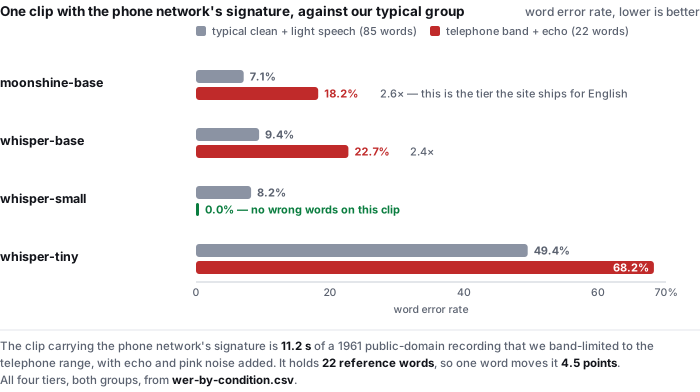
Start with what a voicemail is, because that is the part every page skips. It is not a recording you made. It is a recording somebody else left on a phone system, and it reached you through the phone network, which carries a narrow band of frequencies rather than the full range a microphone captures. Whatever is in that message, the signal has already been narrowed, companded and compressed before it lands in your voicemail box.
So the interesting question is not “which service transcribes voicemails” but “what does that narrowing do to the text”. We have one clip that carries the same signature, and we measured it:
- The clip. 11.2 seconds of a 1961 public-domain recording, band-limited to the telephone range, with echo and pink noise added — 22 reference words. It is the smallest clip in our corpus by reference words.
- The result. The tier this site ships for English went from 7.1% on our typical clean-and-light group to 18.2% on this clip — 2.6×, which is 4 wrong words out of 22. The multilingual base tier went from 9.4% to 22.7% — 2.4×, which is 5 wrong words.
- And the tier you run matters more here. The small tier scored 0.0% on this clip — no wrong words at all — while the tiny tier turned 22 words into 15 errors, 68.2% against 49.4% on the typical group, or 1.4×.
Word error rates are from wer-by-condition.csv in our public benchmark repository: row real_speech_telephone_band_echo (1 clip, 22 reference words) against row typical_clean_and_light_real_speech (4 clips, 85 reference words). Both rows are weighted by reference word count, not averaged across clips. The clip's length and reference word count are from wer-by-sample.csv, row B-hard.
Forty-five seconds is the only length anyone publishes
Before you can say anything about a voicemail's text you need one number: how much audio there is. We went through all nine readable results and looked for it. Two of the nine give a length, and it is the same length, from the same carrier. 7 of 9 give none.
| page | what it publishes about how long a voicemail is |
|---|---|
| verizon.com (support article) | “Only the first 45 seconds of a voicemail message converts to text.” |
| communityphone.org (blog) | “Remember that the first 45 seconds of your voicemail message is what will be converted to text” — in its Verizon section, repeating the same figure |
| nextiva.com | nothing |
| yeastar.com | nothing |
| speakwrite.com | nothing |
| ticnote.com | nothing — publishes a 50 MB upload cap instead |
| any2text.com | nothing — publishes a 15-minute free tier instead |
| voxist (Google Play listing) | nothing — the only mention of length anywhere on the results page is a user review complaining the other way: “I sometimes get lengthy messages, and they don't get truncated.” |
| withallo.com (blog) | nothing — it compares reading speed to listening speed instead |
Read the two rows with a number together and you get the whole shape of the carrier path: the first 45 seconds, whoever is calling, however long they spoke. Read the seven rows without one and you get the shape of the results page: it tells you what to do with the text, and never how much text there is.
- 45 seconds is about 111 words. Our reference text runs at 148.2 words a minute (229 words in 92.7 seconds), so 45 seconds of speech is 111 words. The telephone-band clip itself runs slower — 22 words in 11.2 seconds is 117.9 words a minute — which would make the same 45 seconds about 88 words. Either way: a paragraph.
- One page on the results page quotes reading and listening speeds, and our own number lands inside their listening band. withallo writes that average reading speed is 200–250 words per minute and average listening speed is 100–160, and sells voicemail-to-text as reading instead of listening. Our measured speech rate, 148.2, sits inside that listening band — so their pitch is consistent with a number we can reproduce.
- Our ceiling is 40 times the carrier's. We take 30 minutes of audio per job. 30 minutes divided by 45 seconds is 40. That is not a boast about the product; it is the reason a voicemail is an easy file for a local transcriber — and it is also why the 45-second cap is worth knowing, because it is the only thing on the carrier side that decides how much of your message you ever see.
The two quoted sentences are what those pages publish, read on 2026-10-12; we did not upload anything to them. 111 words is 229 ÷ 92.7 × 60 × 0.75 rounded; 88 words is 22 ÷ 11.2 × 60 × 0.75 rounded; 40× is 1,800 ÷ 45.
Zero of nine pages says what the audio is
Here is the count we did not expect to come out as a round zero. Across all nine readable pages, in every sentence about what a voicemail-to-text service reads, there is no mention of the band, the sample rate, the codec, the bitrate, the channel count or the compression. Not as a warning, not as an explanation, not once. The word “telephone” appears — as a noun for the device, never as a description of the signal.
| what we looked for across the nine readable pages | pages that mention it |
|---|---|
| the band the audio occupies (narrowband, telephone range, 8 kHz) | 0 of 9 |
| the sample rate or the channel count (mono / stereo) | 0 of 9 |
| the codec or the bitrate (kbps, companding, compression) | 0 of 9 |
| how long a voicemail can be | 2 of 9 (both the same carrier's 45 seconds) |
| a denominator for any accuracy figure (test set, corpus, ground truth, sample size) | 0 of 9 |
| an accuracy figure that is qualified by the audio condition | 1 of 9 |
| a number for the carrier's own in-app transcription | 1 of 9 |
Two of those single hits are worth reading closely, because they show what the gap costs.
- The one number for the carrier path, and the silence after it. SpeakWrite writes that in-app transcription “isn’t the most accurate” and that “both Google and Apple’s accuracy rates are reported at only 80%” — then moves on to selling its own service at “99% or higher”. It is the single most useful sentence on the results page and it explains nothing: no band, no codec, no reason. Our own measurement of audio carrying the phone network's signature gives the shipped English tier 18.2% wrong, 81.8% right on 22 words. Two sources that never met land in the same place, roughly four words in five — and only one of them is reproducible.
- The one conditional accuracy figure, printed on a page about voicemail. any2text — whose page is literally /transcribe-voicemail — puts “98% accuracy on clean audio” in its trust bar. A voicemail is the opposite of clean audio: it is narrowband, and it has been through a network. The qualifier is honest and it is also the whole problem, because nothing on that page, or any of the other eight, says what happens when the “clean” condition is not met.
- And the results page is not a list of tools. Two of the nine take an uploaded file, one is a how-to blog, one is an app listing, and five sell voicemail-to-text as a phone-system or transcription-service feature. That is why the page reads like a plan comparison: the people ranking for this phrase mostly want to sell you the line, not read your file.
Counts are over the nine pages we could read out of the ten results: att.com returned HTTP 403 on three different user agents, so it is recorded as not read and excluded from every count. The only denominator-shaped word anywhere in the nine is “datasets” on speakwrite, in a sentence about how the technology was trained — which is training data, not a test set. Accuracy sentences were read in context before being counted, not matched by keyword.
What 45 seconds of voicemail weighs, and what it costs to transcribe
The file is the least of your problems, and it is worth knowing by how much. A voicemail is short and it is compressed, so it is the smallest input in this whole family of words.
| 45 seconds of audio, as | bytes per second | the file | against the 64 kbit/s figure |
|---|---|---|---|
| 64 kbit/s (the telephone standard's rate) | 8,000 | 360,000 B · 0.34 MiB | — |
| our measured 64 kbps MP3 row | 8,263 | 371,835 B · 0.35 MiB | 1.03× |
| uncompressed 44.1 kHz 16-bit mono | 88,239 | 3,970,755 B · 3.79 MiB | 10.7× |
Two things follow. The first is that the byte cap is never the wall for a voicemail: 30 minutes of that audio at 8,263 bytes a second is 14.18 MiB, against our 512 MiB cap, and 512 MiB of it would be 18.0 hours. The second is that the model is the big object, not the message — the first visit downloads 78.4 MiB (82,233,500 bytes) of model, which is 221 times the 45-second voicemail it is about to read.
- The steady-state rate says 13.6 to 15.4 seconds. We measure 18.1 to 20.5 seconds of processing per minute of audio on the long file (1,610 seconds of audio, 485.7 seconds warm and 550.4 seconds cold). Three quarters of a minute of audio at that rate is 13.6 to 15.4 seconds.
- But a voicemail is short enough that fixed costs dominate, so do not read that as a promise. Our shortest measurement is a 13-second clip: 45.2 seconds cold and 23.5 seconds warm. The 60-second clip took 38.9 cold and 24.9 warm. At 45 seconds of audio you are in exactly that zone, where the per-minute rate understates what you will actually wait.
- And on this kind of audio the tier is not a detail. On our telephone-band clip the difference between the smallest tier and the mid tier is 15 wrong words against 5 on a 22-word message. If you are transcribing one voicemail, that is the whole difference between a readable message and a guess.
Byte rates: 64 kbit/s ÷ 8 = 8,000 B/s; the 8,263 figure is our own container-codec-matrix.csv row mp3-none-mp3.mp3, 16,526 bytes for 2.00 s (3.3% above the nominal 64 kbit/s rate); the 88,239 figure is the row wav-none-pcm_s16le.wav, 176,478 bytes for 2.00 s. 45 × 8,263 = 371,835 and 45 × 88,239 = 3,970,755; 88,239 ÷ 8,263 = 10.7. 82,233,500 ÷ 371,835 = 221. Timings are from timing-live-clipquill-com.csv; the model total is from transfer-size-by-file.csv.
What we have not measured
The claim on this page is that the phone network gets to the audio first, and that it costs you words. Both halves are measured, and both have an edge.
- We did not capture a voicemail from a real phone system. Our telephone-band clip is a 1961 public-domain recording that we band-limited to the telephone range, with echo and pink noise added. What we measured is audio carrying the network's signature, not a recording pulled off a carrier's voicemail box. Those are not the same claim and we are not going to blur them.
- It is one clip, and it holds 22 words. One word moves that percentage by 4.5 points; on the 85-word typical group one word moves it 1.2 points — 3.9 times smaller. So the 2.6× is a real measurement on a small denominator, not a law. Do not read it as “voicemail is 2.6 times harder” in general.
- The small tier's 0.0% is the least stable number on this page. The same tier scores 8.2% on the 85-word typical group. A tier that gets 22 words perfect is a fact about those 22 words as much as about the tier.
- The 80% figure is not ours. It is SpeakWrite's statement about Google's and Apple's in-app transcription. We did not measure any carrier's transcription, we did not upload anything to any of the nine pages, and we make no claim about whether their published behaviour matches their published text.
- We did not measure the telephone standard. 8 kHz, roughly 300–3,400 Hz and 64 kbit/s are what the standard specifies; the number we measured is the file, 16,526 bytes for two seconds of our own 64 kbps row, and the error rates above.
- And we have not tested a voicemail's other habits: the automated greeting, a caller who hangs up mid-sentence, hold music, a robocall leaving twenty seconds of silence, or a message that was recorded on speakerphone in a car. Every one of those changes the input, and none of them is in our corpus.
Questions this page answers
Why is my carrier's voicemail transcription worse than the same tool on a clean recording?
Because the audio is not the same audio. A voicemail has been through the phone network before any recogniser sees it — the network carries narrowband speech, not the full-range signal a microphone or a recorder produces. On the one clip in our corpus that carries that signature (11.2 s, 22 reference words, band-limited to the telephone range with echo and pink noise added), the tier this site ships for English got 4 of those 22 words wrong — 18.2%, against 7.1% on our typical clean-and-light group, 2.6×. Whisper-base went from 9.4% to 22.7%. Zero of the nine pages ranking for this phrase that we could read on 2026-10-12 mentions the band, the sample rate, the codec, the bitrate, the channel count or the compression — so the one page that does publish a number for the carrier path (SpeakWrite: “Google and Apple's accuracy rates are reported at only 80%”) cannot say why it is that number.
How long can a voicemail be before the transcription stops?
On the carrier path, 45 seconds. The only published length on the whole first page of results is Verizon's own support page: “Only the first 45 seconds of a voicemail message converts to text.” A blog on the same page repeats the same 45 seconds in its Verizon section. Seven of the nine pages we could read state no length at all. The only place truncation is discussed anywhere on the results page is a user review of an Android voicemail app, praising the opposite behaviour: “I sometimes get lengthy messages, and they don't get truncated.” Our own ceiling is 30 minutes of audio per job — 40 times the carrier's 45 seconds.
How many words is a 45-second voicemail?
About 111 words, at the speech rate we measured on our own reference text: 229 reference words in 92.7 seconds is 148.2 words a minute, and 45 seconds of that is 111 words. The one clip carrying the phone network's signature ran slower, 117.9 words a minute, which would make the same 45 seconds about 88 words. Either way it is a paragraph, not a document — and at 64 kbit/s, the rate the telephone standard specifies, 45 seconds of it is 360,000 bytes, about a third of a megabyte. One page ranking for this phrase reports reading speed at 200–250 words a minute and listening speed at 100–160; our measured 148.2 sits inside their listening band.
What does the phone network actually do to the audio before I transcribe it?
It narrows it. The public telephone network carries a narrow band of frequencies rather than the full range a recorder captures — the published standard is roughly 300 to 3,400 Hz, sampled at 8 kHz and companded at 64 kbit/s. We did not measure that standard; what we measured is a clip with that signature, and what it does to the text. On our telephone-band clip of 22 reference words, whisper-tiny turned it into 15 wrong words (68.2%), whisper-base into 5 (22.7%), and the shipped English tier into 4 (18.2%) — while on our 85-word typical group those same tiers scored 49.4%, 9.4% and 7.1%. The compression matters too: 45 seconds at 64 kbit/s is 360,000 bytes, and the same 45 seconds uncompressed at the rate our own .wav row measures is 3,970,755 bytes, 10.7 times more, for the same words.
Can I put my own voicemail through this site?
Yes, if you can get the audio out of your phone as a file — voicemail-to-email features deliver it as an attachment, and some carriers let you share or save the message. Size is not the problem: 45 seconds at 64 kbit/s is about 0.35 MiB, against our 512 MiB cap, and 30 minutes of that audio is 14.18 MiB. The model download is the bigger number: 78.4 MiB, which is 221 times the voicemail itself. Expect roughly 13.6 to 15.4 seconds of processing for 45 seconds of audio at the steady-state rate we measure (18.1 to 20.5 seconds per minute of audio) — but do not treat that as a promise: our shortest measurement, a 13-second clip, took 23.5 seconds warm and 45.2 seconds cold, because fixed costs dominate a short file.
Where the raw data is
The error rates, file sizes and timings on this page come from the same published measurement run as the rest of this site.
- Raw data and the measurement scripts — github.com/supersophia8888-cloud/clipquill-asr-benchmark, including the raw model text behind every number, so the scoring can be redone under different rules.
- Archived copy with a DOI — 10.5281/zenodo.22826968, the concept DOI: that link always resolves to the newest version of this dataset, all versions.
- The same data as a dataset — huggingface.co/datasets/sophia8888/clipquill-asr-benchmark
- The telephone-band clip, four tiers, two groups — wer-by-condition.csv in the repository.
- Where the 22 reference words and 11.2 seconds come from — wer-by-sample.csv, row B-hard.
- Dropped words and hand-fix spots on the same clip — edit-load-8-clips.csv.
- The 64 kbps and uncompressed byte rates — container-codec-matrix.csv, twenty encodings of the same two seconds.
- The 78.4 MiB first visit and the 18–20.5 s per audio minute — transfer-size-by-file.csv and timing-live-clipquill-com.csv.
- The same measurement on an audio file with a cap written in two units — eight pages publish a limit, and only one tells you which one you will hit
- What a percentage means when nobody gives the denominator — 28 pages quote an accuracy percentage, 0 say what it was measured on
Run it on your own voicemail
The transcriber is on the front page of this site. It reads the file in your browser tab, which means the audio never leaves your machine — and a voicemail is the easiest file it will ever see: 30 minutes of audio and 512 MiB per job, against a message that is usually 45 seconds and a third of a megabyte. Expect the first run to spend about 78.4 MiB on the model download and roughly a gigabyte of RAM, and expect 18–20.5 seconds of processing per minute of audio once it is warm.