The container is the easy part
An MP3 is a compressed audio container. Turning it into text is speech recognition of the audio stream inside it, not a format conversion in the sense that Zamzar converts file types. The browser decodes the MP3 to raw samples and a model reads them. We read the first page of results for mp3 to text on 2026-10-05: ten organic results, ten distinct domains, the same ten from Bing and DuckDuckGo (DuckDuckGo draws on Bing’s index, so one count). 7 of 10 returned readable text; three answered HTTP 403 or were JavaScript shells. In those seven, the words convert and converter appear between 79 and 242 times per page. None of them tells you that the result depends on the audio, not the label.
- The MP3 is small and the browser reads it natively. In our container matrix the same two seconds of audio is 16,526 bytes as MP3 and 176,478 bytes as WAV PCM — an 11× size difference for the same words. That works out to about 8,000 bytes per second at 64 kbps, so a twenty-minute interview is only about 9.6 MB. Every one of the eight common audio containers (MP3, WAV, OGG, M4A, MP4, MOV, WebM, AAC) decodes in a real Chrome tab.
- So the format is the cheap step. Whatever the wrapper, the decoder turns it into the same PCM samples, and the recognizer hears those. The container decides how much disk the file takes and whether your player opens it. It does not decide what the words are.
- Transcribe mp3 is the same job. The phrase swaps the word order and changes nothing about the work; this page covers both, because the model does not know which verb you typed.
Counted on 2026-10-05 from our saved copies of the results page for mp3 to text. The 8,000 bytes per second is the definition of 64 kbps; the 16,526-byte MP3 and 176,478-byte WAV are read from container-codec-matrix.csv in the public repository, measured 2026-09-18 with a real Chrome window. The decode claim is from decode-format-support.csv.
What the text actually depends on
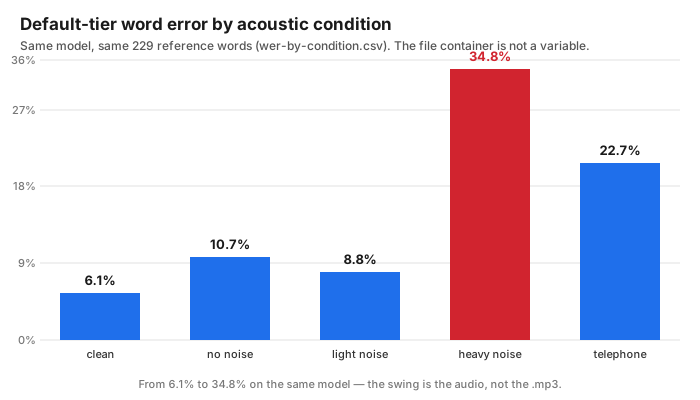
If the container does not matter, something does. On our benchmark the variable is the acoustic condition of the audio — how clean it is, what noise sits under the voice, whether it came through a telephone band. The set is eight clips and 229 reference words, scored against the default tier with the same normalized word-error scorer the site publishes.
| acoustic condition | clips | reference words | default-tier WER |
|---|---|---|---|
| clean synthetic speech | 1 | 33 | 6.1% |
| real speech, no added noise | 2 | 28 | 10.7% |
| light background noise | 2 | 57 | 8.8% |
| heavy background noise | 2 | 89 | 34.8% |
| telephone band + echo | 1 | 22 | 22.7% |
| all eight clips | 8 | 229 | 20.1% |
| clean + light real speech only | 4 | 85 | 9.4% |
Read across the rows and the point is the spread, not any single number. The same model, the same scoring, a 6.1% to 34.8% range — and the column headed “file type” does not exist, because we never varied it. A page that headlines an accuracy percentage without telling you which of these rows it is measuring is not telling you what you would get on your own recording.
- A second tier is offered if you want lower error. The optional higher-precision model scores 9.6% across all eight clips and 8.2% on the clean-plus-light grouping, against 20.1% and 9.4% for the default. It is the same pattern — the audio dominates — at a larger download. We are not going to call one “better”; both are in the repository so you can score them on your own audio.
- 0 of 7 of the top pages state what their number was measured on. Across all seven saved copies we searched for a test set, a corpus, a word-error rate, a sample size, or the words measured on, and found none. They print “accuracy” constantly and a denominator never.
All percentages are from wer-by-condition.csv in the public benchmark repository. WER is total errors divided by total reference words (weighted), not an average of per-clip percentages. The 229-word total is the scorer count after apostrophe splitting, documented in the repository README.
Where the file goes
The second thing the seven pages do not line up on is privacy, and here the set has split since the last time we looked at this market.
- 2 of 7 say the file stays on your device. Earscribe answers its own FAQ “Can I convert MP3 to text without uploading it?” in the affirmative, and Uniscribe writes “browser-based conversion — files never leave your device” and “all processing happens locally on your device.” That is a real change from a market where every page sent the file to a server.
- The other 5 of 7 are silent or explicit uploads. None of the remaining five says where the file goes, and four of them are upload-and-process web services whose entire model is that your audio reaches their machines. A page that never mentions your file after you click Convert has decided for you where it goes.
- Says local is not is local. A claim in a marketing sentence is not the same as an open model running in the tab you can watch. Our tool loads the recognizer into the browser, reads the audio there, and sends nothing to a server — there is no account step that would require it.
The local-processing claims were read from our saved copies of the Earscribe and Uniscribe pages on 2026-10-05. We have not uploaded a file to any of the seven and make no claim about whether their limits are enforced as written — only that the privacy story on the first page for this phrase is now two-sided instead of one.
Questions this page answers
Is mp3 to text a file conversion?
No. An MP3 is a compressed container holding an audio stream, and turning it into text is speech recognition of that audio, not a format conversion. The browser decodes the MP3 to raw samples and a speech model reads them. Our container matrix holds the same two seconds of audio at 16,526 bytes as MP3 and 176,478 bytes as WAV PCM — an 11× size difference with the same words. The container changes how much disk the file takes, not what comes out as text.
What actually determines how accurate the text is?
The audio, not the file type. On our measured set the default tier scores 6.1% word error on clean synthetic speech, 10.7% on real speech with no noise, 8.8% with light noise, 34.8% with heavy noise, and 22.7% on a telephone-band clip. Same model, same 229 reference words; only the acoustic condition changes. The question of mp3 versus wav never enters the equation, because the recognizer hears the decoded audio either way.
Do these sites keep my MP3 private?
Of the seven readable results, 2 (Earscribe, Uniscribe) say the file is processed in your browser and never leaves your device. The other 5 say nothing about where the file goes, and four of those are explicit upload-and-process services. Saying it runs locally is not the same as being able to see it run locally. Our tool loads an open model into the tab and the file is never sent anywhere.
What does mp3 to text cost on a private tool?
Running it in the browser, the first visit downloads about 78.4 MiB for the model and the job uses roughly a gigabyte of memory; the audio file itself is not uploaded. The caps are 30 minutes of audio and 512 MiB per file, and for any standard audio it is the 30 minutes that binds.
Where the raw data is
The container sizes, the per-condition error rates, and the decode support on this page come from the same published measurement run as the rest of this site.
- Raw data and the measurement scripts — github.com/supersophia8888-cloud/clipquill-asr-benchmark, including the raw model text behind every number, so the scoring can be redone under different rules.
- Archived copy with a DOI — 10.5281/zenodo.22826968, the concept DOI: that link always resolves to the newest version of this dataset, all versions.
- The same data as a dataset — huggingface.co/datasets/sophia8888/clipquill-asr-benchmark
- The per-condition error rates — wer-by-condition.csv in the repository, the same model on the same 229 words across five acoustic conditions.
- Why the container barely matters — the extension is not what it converts
- What an accuracy number means when it has no denominator — five pages make an accuracy claim, and not one says what it was measured on
- The wall on the other side of the file — five pages ask where your recording goes, and all five answer “to us”
Run it on your own file
The transcriber is on the front page of this site. It reads the audio in the tab and writes the words from it, so the file does not leave your machine. Expect the first run to spend about 78.4 MiB on the download and roughly a gigabyte of RAM, then the recognition runs on your own audio. Accuracy is the 20.1% figure with the conditions named — and if your recording is clean, read speech, the honest comparison is the 9.4% grouping, not the headline. The caps are 30 minutes of audio and 512 MiB per file, checked before any work starts, and for any standard audio file it is the 30 minutes that will stop you.