Questions people actually ask about this phrase
What format is a WhatsApp voice note, and does it need converting?
It is Opus, and it does not need converting. Five of the 9 pages ranking here name Opus, and four of those five tell you to upload it as it is — Wave AI: "WhatsApp .opus voice messages and other audio… uploads as it is"; freeonlinetranscribe: "We accept the native WhatsApp .opus and .ogg formats directly — no need to convert to MP3 first"; voicetotext.pro: "They download as .ogg files (Opus audio), which Voice to Text supports directly — no conversion step". We ran six .opus files through our own page in one session, from 4,742 bytes to 23,131 bytes: 3 were accepted on the first load, and the other 3 needed a second load — on the first one the page never moved off “Reading the file…” and had to be given the same file again. The conversion step some tools ask for is adding bytes, not accuracy, for the reason the table below measures.
How many bytes does a second of voice note cost?
Measured, not published. At 12 kbit/s the file runs 1,582 bytes a second; at 24 kbit/s, 3,023 bytes a second. That puts a 60-second note at about 181,404 bytes and thirty minutes at 5,442,118 bytes, 5.2 MiB. The 9 readable pages ranking here give no bytes-per-second figure and no bitrate, so there is nothing to check those numbers against — which is exactly why the file-size question gets answered twice by the same page, once in MB and once in minutes, and never in the unit that would let you multiply.
Does the bitrate of a voice note change the transcript?
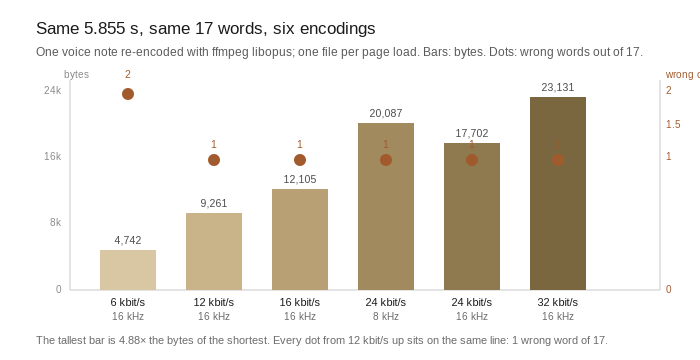
Between 12 and 32 kbit/s, no, and the evidence is byte for byte. Four files — 12, 16, 24 and 32 kbit/s, all 16 kHz mono Opus, from 9,261 to 23,131 bytes — returned the same 88 characters, the same 17 words and the same one wrong word, all four hashing to ae9a38cfd60f2206. At 6 kbit/s the file is 4,742 bytes and the transcript changes: “Mr. Quilter” becomes “Mr. Kroldor”, the text hashes to 02814f92c26021df, and the score goes from 1 wrong word to 2. The floor is between 6 and 12 kbit/s, not at the top of the range.
Does 8 kHz instead of 16 kHz hurt the transcript?
Not in this test. Holding the bitrate at 24 kbit/s and dropping only the sample rate from 16 kHz to 8 kHz took the file from 17,702 bytes to 20,087 bytes — the smaller bandwidth file is the larger file — and left the transcript identical: same hash, same single wrong word. We report that as a null result, not as a rule. One 17-word sentence is a small sample, and at a lower sample rate an encoder spends its bits on fewer frequencies, so the two files are not the same experiment repeated at two sizes.
How long a voice note can this page take?
Thirty minutes of audio or 512 MiB per job, whichever comes first — and for voice notes the clock always comes first. At 3,023 bytes a second, thirty minutes is 5,442,118 bytes, that is 5.2 MiB, which is 1.01% of the 512 MiB guard. The two guards would only meet at about 2,960 minutes of audio at this bitrate. So the honest answer to "can I drop this 40-minute note in" is no, and the reason is the audio clock, not the size of the file.
Is the voice note uploaded anywhere?
Not to us. The model runs in the browser tab you already have open, and the file is read by that tab. That matters more here than for most files, because a voice note is somebody else's words and it was never addressed to you: 8 of the 9 readable pages ranking for this phrase describe uploading the note to a provider. The first run on this page therefore costs a model download instead of an upload: on this morning the first of the six loads took 81.9 seconds for 5.855 seconds of audio, and the same five-second clip cost 13.0 seconds once the model was in the browser. One page, WhatsApp's own announcement from November 2024, describes the other kind of local transcription — "Transcripts are generated on your device so that no one else, not even WhatsApp, can hear or read your personal messages" — and that is the built-in feature, not a website.
Can I transcribe a whole exported WhatsApp chat?
Not in one job. An export gives you a folder of separate .opus files, and this page takes one file per job up to 30 minutes of audio. The 9 pages split on the same question: four walk you through exporting and then stop at a single note, one routes it through a WhatsApp bot instead of a file at all, and 0 of the 9 tells you what a batch of twenty notes costs in time. Twenty notes at the measured 13–82 seconds each is the honest range on our machine, not a promise.
One 5.855-second note, six bitrates, one variable
Three phrases sit behind this page — whatsapp voice note to text, whatsapp voice message to text and transcribe whatsapp voice notes. Searched on 2026-11-22, they returned heavily overlapping result sets, and the top ten for the first phrase is the one counted below: 10 results across 8 registered domains (audionotes appears twice). 9 of the 10 had a body we could read and count. The one that did not: reddit.com/r/whatsapp returned 403 at every user agent we tried, and it is left out of every denominator rather than guessed at.
What the 9 readable pages do and do not say
- Five name Opus. None of the five gives it a number. Wave AI ("WhatsApp .opus voice messages"), SpeakApp (accepted formats "OPUS, M4A, OGG, MP3"), RecordMeeting, freeonlinetranscribe and voicetotext.pro all know the codec by name, and one of them even describes it as the "low-bitrate Opus codec that WhatsApp uses". Bitrate, kbit/s, kilobit: 0 of the 9. Sample rate, kHz, 16 kHz: 0 of the 9. The word "bitrate" appears exactly once on the entire set and carries no number. Every page here sells you a reading of a compressed file without saying how compressed it is.
- Seven of the 9 state a length or size limit, in a unit you cannot convert. Wave AI "up to 60 minutes"; AudioPen "up to 60 minutes and 100 MB"; freeonlinetranscribe "about one hour per file"; voicetotext.pro "files up to 200 MB"; RecordMeeting "3 free transcriptions a day, up to 15 MB and 10 minutes each"; Audionotes "up to 6 hours per recording, 500 MB per audio/video upload"; Talknotes "up to 5MB" for a file and "up to 1 minute of audio" for the free tier. Two publish both halves — AudioPen (60 min / 100 MB) and RecordMeeting (10 min / 15 MB) — and neither does the division. AudioPen's own pair implies 1,667 bytes a second and RecordMeeting's implies 25,000, a 15× spread that no page explains and that not one of the 9 comments on.
- None of the 9 says what a second of voice note costs. Bytes per second, kB/s, kbit/s and KiB/s: 0 of 9. The consequence is a page that cannot tell you whether your 4,742-byte note and your 23,131-byte note are the same audio. Ours can: they are, and so are the 9,261 and 17,702 versions, byte for byte, down to the hash.
- Two print an accuracy percentage, and neither gives it a denominator. SpeakApp "99% Accuracy" and Audionotes "95% transcription accuracy across the most popular languages". A third candidate, Talknotes' "100% Free" headline, is a price and was dropped. Words test set, ground truth, reference transcript, sample size and validation set: 0 of the 9. Against ours: 17 reference words, one wrong — and we publish the wrong word, because at this sample size one word is 5.88%.
- Eight of the 9 describe uploading the note somewhere. "upload it here", "drop the exported audio file here", "upload your audio file". The remaining helper is Audionotes' WhatsApp bot, which asks for your number and gets the voice notes forwarded to it — a different route to the same place. One page (AudioPen) does offer an offline option, and it is its desktop and phone app, not the converter the page is selling.
- Zero of the 9 prices the process, and the pages that give a speed give it in adjectives. "In seconds", "under a minute", "in a couple of minutes": 6 of 9 say something like that, and 0 of 9 gives seconds per minute of audio. We measured ours at 13.0 to 81.9 seconds for a 5.855-second note across the six runs — the first run in the session carries a model download and the last three carry a machine that had been working for thirteen minutes, which is why that range is wide. It is a range, and it is stated.
Counts are over the 9 pages we could fetch and read on one day, and the hits were read in context before they were counted, which is how two candidate hits were dropped: Talknotes' "100% Free" would parse as an accuracy percentage but is a price, and its "50+ languages" sits one line from "Transcribe up to 1 minute of audio at a time" — a limit on audio, not on languages. Where a page returned 403 or a shell we say so and leave it out of every denominator rather than guess.
How the six files were made, and what single variable each one changes
The material is one existing read-speech clip from our own benchmark with a known reference: C1, 5.855 seconds, 17 words, already 16 kHz mono at 24.7 kbit/s as an MP3. Each version below is that same clip decoded once and re-encoded once with ffmpeg's libopus encoder, and then handed to the live page, one file per page load in a throwaway browser profile, in the order shown. Nothing else changed: no gain, no resampling of the source, no trimming.
| encoding | sample rate | bytes | bytes per second | wrong words | transcript hash |
|---|---|---|---|---|---|
| 6 kbit/s mono | 16 kHz | 4,742 | 810 | 2 / 17 — 11.76% | 02814f92c26021df |
| 12 kbit/s mono | 16 kHz | 9,261 | 1,582 | 1 / 17 — 5.88% | ae9a38cfd60f2206 |
| 16 kbit/s mono | 16 kHz | 12,105 | 2,067 | 1 / 17 — 5.88% | ae9a38cfd60f2206 |
| 24 kbit/s mono | 8 kHz | 20,087 | 3,431 | 1 / 17 — 5.88% | ae9a38cfd60f2206 |
| 24 kbit/s mono | 16 kHz | 17,702 | 3,023 | 1 / 17 — 5.88% | ae9a38cfd60f2206 |
| 32 kbit/s mono | 16 kHz | 23,131 | 3,951 | 1 / 17 — 5.88% | ae9a38cfd60f2206 |
Two rows are a controlled pair and worth naming as such. 12 versus 32 kbit/s is a bitrate difference of 2.5× in bytes (9,261 against 23,131) with nothing else changed, and the output is the same 88 characters. 24 kbit/s at 8 kHz versus 24 kbit/s at 16 kHz is a sample-rate difference with the bitrate held — and it produced the larger file at the lower rate, 20,087 against 17,702, because at 8 kHz the encoder is asked to spend the same bits on half the spectrum. The transcript did not move. Neither row is a proof that bitrate never matters; both are a proof that above some floor, this recogniser is paying for bits it does not use.
The 6 kbit/s row is where the floor shows up, and the way it shows up matters. The wrong word is a name — “Quilter” heard as “Kroldor” — and the rest of the sentence survives intact. That is what a shortage of bits sounds like to a recogniser: the consonants that carry a word's identity blur first, and the words around them hold. It is also why the score moves by only one word while the sentence stays readable, and why one wrong word on a 17-word reference reads as 5.88% while the same wrong word on a two-minute note would be a fraction of that. The percentage is not portable; the word is.
One run per file, six page loads in one browser profile, in the order shown. The first run of a session carries the model download and must not be compared with the later rows; its transcript still counts. The clip predates this test and its 17-word reference was fixed before the six files were encoded.
The floor is not at the top of the range, and that changes what to do with a note you can barely hear
Every page in this set writes its limit as "up to N minutes", and every one of them treats a voice note as something you hand over whole. The measurement above says something different about the size half of that. Take the largest file here, 32 kbit/s at 23,131 bytes for 5.855 seconds, and the smallest, 6 kbit/s at 4,742 bytes: 4.88× the file, and the difference in output is one word. The extra 18,389 bytes carried nothing the recogniser used.
That is worth knowing when a note will not go through. A page that answers "file too large" or "too long" is describing its own clock or its own storage, and none of the 9 readable pages here explains which of the two it is: AudioPen publishes 60 minutes and 100 MB and does not say whether the minute cap, the megabyte cap or neither is the one that bit you. On this page the guards are 1,800 seconds and 512 MiB, and at the measured 3,023 bytes a second, 512 MiB would hold 2,960 minutes — 98.7× the thirty minutes the clock allows. Thirty minutes of voice note is 5.2 MiB. Nothing about it comes close to 512 MiB.
The practical version: if a note is too long, the fix is to split it, not to squeeze it. Re-encoding 24 kbit/s down to 12 kbit/s halves the bytes (47.68% smaller, 9,261 against 17,702) and, in this measurement, cost zero words — but it buys you 2.7 MiB instead of 5.2 MiB on a thirty-minute note, which matters to a messenger's storage budget and not at all to a 512 MiB guard. Squeezing buys tokens on the wire. It does not buy minutes of audio, and on this page minutes are the wall.
Where squeezing does cost is below the floor, and the shape of that cost is worth one sentence because it is easy to misread from a percentage. At 6 kbit/s the score is 11.76% against 5.88% — a doubling that sounds like a big number. It is one extra wrong word, in a name, on a sentence that still reads. A page that printed "11.76% versus 5.88%" without the words would be telling you something true and useless.
Getting the note out of the chat, and what the methods cost
Every page in this set has an export section, and they disagree about the file extension, which is the least interesting disagreement in the set but the one you hit first. Wave AI says the saved file "is usually an .opus file". voicetotext.pro says the WhatsApp Web download "saves as an .ogg file". freeonlinetranscribe says both: ".opus or .ogg files". All three are describing the same container; what changes between a phone export and a desktop download is the wrapper, not the codec, and our page accepted both shapes in this session without being told which was coming.
The bigger difference is what happens to the note after it is out. Four of the 9 walk you to the point of an uploaded single file and stop. One, Audionotes, wants your number instead: the note is forwarded to a WhatsApp bot and the transcript comes back in a chat. Two (Talknotes and SpeakApp) offer a bot or an app as an upgrade path above the file upload. Only one page in the whole set raises the thing you actually run into with a chat export — that it arrives as a folder of twenty files, not one — and it answers it by telling you to "upload the voice notes you need most". That is an honest answer and it is still not a batch.
On this page the batch question has a plain answer: one file per job, up to 30 minutes each, and no queue. Twenty notes is twenty jobs. Nothing is metered and there is no account, because the work happens in the tab, but neither is there a button that eats a folder.
What this measurement does not cover
- One sentence, seventeen words. That is one wrong word per 5.88 percentage points, so every score on this page moves in coarse steps and the difference between the 12 kbit/s row and the 32 kbit/s row is one word, not zero errors. A 500-word recording is the experiment that would settle whether 12 kbit/s and 32 kbit/s are equal or merely indistinguishable at this size.
- We did not record a voice note on a phone. The source clip is read speech at 16 kHz, re-encoded with ffmpeg's libopus encoder. A real note comes from a phone's microphone in a room, through WhatsApp's own encoder at its own bitrate. What this page measures is what the recogniser does with a given bitrate; it does not measure what WhatsApp picks.
- The bitrates are targets, not results. The files were encoded at 6, 12, 16, 24 and 32 kbit/s and the resulting sizes (4,742 to 23,131 bytes over 5.855 seconds) show the encoder landed near each target rather than exactly on it. Short files carry container overhead in the same bytes.
- One model, one tier. The default English tier this page ships. A larger model might hold the name together at 6 kbit/s, and this page does not say what it would cost to try.
- Timing is one observation per row. Six files, six loads, one machine, one morning. The 13.0 s run and the 81.9 s run are three hours apart in load conditions, not a speed comparison, and none of the six should be read as a claim about throughput.
- We ran none of the 9 pages. Nothing was uploaded to them and no figure here measures their products. Where their copy is quoted it is quoted as their claim about themselves, unverified — including the two pairs of limits (60 min / 100 MB, 10 min / 15 MB) that we divide here and they do not.
Try it on the note you were sent
The transcriber is at the top of this page. It takes the file you already have — MP3, WAV, M4A, MP4, WebM, OGG, AAC, FLAC or the .opus the chat gave you — up to 30 minutes of audio and 512 MiB per job, and the model runs inside your browser tab, so the note is not uploaded. Expect the first run to be the slow one: the model has to come down before any audio is read, and on the morning of 22 November a 5.855-second note cost 81.9 seconds on its first load and 13.0 seconds on a later one. You get timestamped text out as TXT, SRT or VTT, and the SRT files recaptured from this domain on 21 November never emit a line wider than 42 display-width units. There are no speaker labels — a voice note is one person, and a page that promises otherwise is promising something this recogniser does not do.