Questions this page gets asked
What does a music bed do to a two-voice Reel transcript?
It stacks on top of the damage the second voice already does. On this page, two speech streams starting together came back at 44.9% word error rate with no music - 22 errors of 49 reference words - and at 73.5% with the bed at equal loudness, 36 errors of the same 49. The same bed at 12 dB over the program took it to 79.6%. The transcript length holds at equal loudness - 32 words out, the same as with no bed, on the page's own whitespace count - and grows to 35 with the bed 12 dB over; the scorer's token count reads 36 and 38 for those two rows because it splits hyphenated words such as year-glad into two. The extra words at 12 dB over are wrong.
Do any Instagram transcript tools say what the music costs?
Sixteen of the 25 pages we read mention the music, each of them in a single line of an accuracy-depends-on FAQ. One page, musely.ai, attaches numbers - 99.1% on clean speech against 92-95% with heavy music beds - and that is a range with no denominator, no definition of heavy and no level in dB. None of the 25 prints a level in dB for the music or the speech, and none of them measures the music and a second voice together.
How loud does the music have to be before it costs words?
In our run the count did not move at 24 dB under the program - 22 errors of 49, the same as no bed - and jumped to 28 errors at 12 dB under. From there it rose with level: 36 errors at equal loudness and 39 with the bed 12 dB over. With one run per file we read the first two rows as one observation, not a law, but the direction is consistent across the four levels.
Does the music hurt a transcript with only one voice in it?
Not in our run. The second stream alone came back at 6.2% word error rate - two errors of 32 reference words - and the same stream with the bed at equal loudness also came back at 6.2%, two errors of 32. Which two errors moved: without the bed the model wrote rose for roast and in for and; with the bed it wrote rose for roast and inserted an a before rose beef. The same clip carried an eight-level bed ladder on our TikTok page on 10-18, where one to two words were wrong at every level from 24 dB under to 12 dB over.
Can I paste an Instagram link into this site?
No. This page transcribes a file you already have: save the Reel, then drop the file on the front page. All 25 pages we read take a link or a URL. What you get here in exchange is that the recognition runs inside your browser tab and the file is never uploaded. The ceiling is 30 minutes of audio and 512 MiB per job.
How many words is a remix Reel transcript?
At the 148.2 words a minute our own reference material runs at - 229 words over 92.7 seconds - a 15-second Reel holds about 37.1 words, a 30-second one 74.1 and 90 seconds 222.3, so one wrong word is 2.70, 1.35 or 0.45 points on those lengths. For the remix case the comparison that matters is 44.9% wrong against 73.5% wrong: on a 30-second two-person exchange, about 74 words, that is roughly 33 wrong words against roughly 54, printed as scale and not as a prediction.
Sixteen pages mention the music. One of them prints a number.
◇The music is not a secret in this family: sixteen of the 25 pages we read mention it, and every one of the sixteen does it in prose, in a line about what accuracy depends on. ◇Ten of the sixteen mention the music and say nothing about a second voice; the other six are in the next section. ◇This is the list of the ten, quoted, not selected.
| page | what it says about the music |
|---|---|
| https://www.musely.ai/tools/instagram-transcript-generator | “Musely uses an acoustic model trained on social-video audio, so it tolerates background music, room reverb, and most regional accents. On clean speech accuracy averages 99.1%; with heavy music beds expect 92-95%.” |
| https://www.choppity.com/tools/instagram-video-to-transcript/ | “It works with any video length and handles background music, voiceovers, and on-camera speech.” “Our AI handles the fast-paced, music-heavy audio that’s typical of Instagram Reels.” “The AI isolates speech from background music and trending audio.” |
| https://elevenlabs.io/instagram-transcript-generator | “Scribe delivers clean text from Reels recorded on phone mics, over music beds, or mid-crowd, and it leads accuracy benchmarks.” |
| https://transcriptmagic.com/instagram-reel-transcript/ | “Background music common to Reels can reduce accuracy on the spoken portions, but the dialogue still comes through cleanly.” |
| https://speakapp.com/t/tools/instagram-transcript | “SpeakApp achieves up to 99% accuracy on clear audio. Accuracy depends on audio quality, background music, and speaker clarity.” |
| https://www.transcript365.com/free/instagram-transcript/ | “It precisely processes popular videos, background music, and various accents.” |
| https://videototextai.com/tools/instagram-to-transcript | “optimized to handle music, dialogue, and voiceovers accurately”; “can also extract lyrics from songs featured in Reels” |
| https://eden.so/tools/instagram-transcript-generator/ | “Reels with no speech (music only) have nothing to transcribe” |
| https://www.manyscripts.com/instagram-transcript | “the Reel uses only music or sound effects with no voiceover, so there is nothing to transcribe” |
| https://tokscript.com/instagram-transcript-generator | “If a Reel contains only music, ambient sound, or visual content with no spoken words, there is nothing to transcribe.” |
◇One of the sixteen attaches a number to the music, and it is worth reading closely: musely prints 99.1% on clean speech against 92–95% with heavy music beds. ◇That is a range with no denominator, no definition of “heavy”, no level in dB and no description of the test — it can be quoted, and it cannot be checked. ◇The other fifteen attach nothing at all.
◇And no page in the set prints a level. ◇The words dB, decibel, loudness and signal-to-noise appear nowhere on the 25 in a transcription context; the only dBFS strings in the whole crawl are template placeholders — “{peak} dBFS” — inside screenapp’s separate audio-quality checker, a different tool with no values filled in. ◇So the family’s own answer to “how loud is too loud” is that nobody says.
The six pages that name both problems leave both in words
◇Six of the 25 mention two voices or overlapping speech, and all six are the same six that mention the music — the “accuracy depends on” FAQ is where both problems live, one word each. ◇This is the whole list.
| page | what it says about the music and the second voice |
|---|---|
| https://getthescript.app/instagram-transcript | “Collab posts and remixes confuse the output. Why?” — “Two audio layers (original + remix voiceover) overlap. Transcribe the original Reel separately for a clean script, then note the remix commentary by hand.” And: “Overlapping speech is the top accuracy killer.” And, on the bed: “Light beds are fine; loud soundtracks over quiet narration hurt accuracy.” |
| https://screenapp.io/transcription/instagram | “Accuracy depends on the audio: a clear voiceover transcribes well, while loud background music or overlapping speech drops accuracy.” |
| https://www.gettranscribe.ai/ | “Music, overlapping speakers, strong accents, and recording quality can affect results.” On the same homepage, for duets: “Both speakers’ audio is captured in the single transcript.” |
| https://www.subclip.app/tools/instagram-video-transcript | “heavy background music, overlapping voices, and compression artifacts can reduce accuracy” |
| https://supadata.ai/instagram-transcript | “Typically 90%+ for clear speech. Background music, several people talking at once and strong accents lower accuracy.” |
| https://www.dictationer.com/paste-link/instagram-to-text | “For best results, use videos with clear voices and minimal music overlap.” |
◇Not one of the six attaches a number to either problem, and none of the six puts the two in one sentence with a measurement. ◇The sharpest of the six on the remix case is getthescript: it names the file structure — two audio layers, the original plus the remix voiceover — and then answers with a workaround, transcribe the two sides separately and note the second one by hand. ◇That is a workaround for a number nobody printed: what the bed costs while it is still under the second voice.
The test: one arrangement, five beds, and the controls the same day
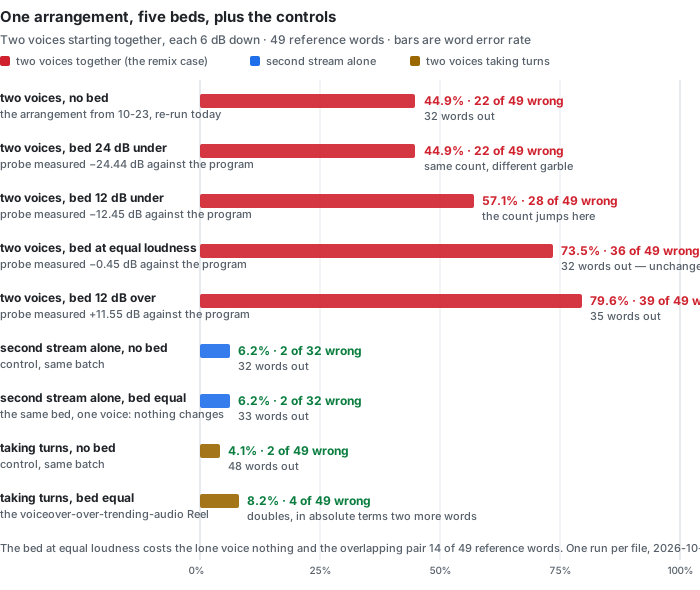
◆One variable: the music bed. ◆The two speech streams and their arrangement are the ones from our duet page on 10-23, unchanged — A is 5.855 seconds with 17 reference words, B is 12.485 seconds with 32, both one speaker reading two sentences, and they start together with each stream 6 dB down. ◆The bed is the same synthesised one our TikTok page used on 10-18: a sustained C major triad at 261.63, 329.63 and 392.00 Hz under a 70 Hz pulse every 0.5 seconds, 120 BPM. ◆Its RMS was set against the RMS of the program it sits under, at four levels: 24 dB under, 12 dB under, equal, and 12 dB over. ◆Bed-only probes encoded the same way measured −24.44, −12.45, −0.45 and +11.55 dB against the program file — the constant −0.45 dB is the MP3 encoder’s end padding acting on a continuous signal, and the 12 dB steps between levels are exact.
- Two controls the same day. ◆The second stream alone, with and without the bed at equal loudness — the question the bed has to answer first, since a bed that costs a lone voice nothing cannot be the thing that breaks a duet. ◆And the two streams taking turns, with and without the bed — the voiceover-over-trending-audio Reel.
- Nine files, nine runs. ◆Every file was built with ffmpeg — one decode, one encode — at 16 kHz mono 24 kbit/s, and handed to the live page in a real Chrome window with a fresh profile, one file per page load, on 2026-10-24. ◆The page’s own output was read back, counted and hashed; the run is recorded in
data/instagram-music-second-voice-2026-10-24.csv. - No clipping. ◆The loudest mix peaked at −7.37 dBFS, so nothing in the set is distorted on the way in.
- The bytes do not move. ◆All five 12.485-second files are exactly 37,916 bytes and both 18.340-second files exactly 55,520: at a fixed bitrate the size is a function of duration alone, so in our own files the bed adds no bytes at all. ◆That is a fact about our encoder settings, not about Instagram.
| file | arrangement | music bed | bytes | page’s clock | output | errors | word error rate |
|---|---|---|---|---|---|---|---|
| ctrl-nomusic.mp3 | two voices together, each 6 dB down | none | 37,916 | 30.1 s (cold) | 186 chars / 32 words | 22 of 49 | 44.9% |
| bed-m24.mp3 | same | 24 dB under | 37,916 | 12.5 s | 185 chars / 32 words | 22 of 49 | 44.9% |
| bed-m12.mp3 | same | 12 dB under | 37,916 | 7.0 s | 182 chars / 32 words | 28 of 49 | 57.1% |
| bed-0.mp3 | same | equal loudness | 37,916 | 8.0 s | 193 chars / 32 words | 36 of 49 | 73.5% |
| bed-p12.mp3 | same | 12 dB over | 37,916 | 8.0 s | 206 chars / 35 words | 39 of 49 | 79.6% |
| solo-b-plain.mp3 | second stream alone | none | 37,916 | 7.0 s | 173 chars / 32 words | 2 of 32 | 6.2% |
| solo-b-bed0.mp3 | second stream alone | equal loudness | 37,916 | 6.9 s | 176 chars / 33 words | 2 of 32 | 6.2% |
| seq-plain.mp3 | A then B, taking turns | none | 55,520 | 9.5 s | 264 chars / 48 words | 2 of 49 | 4.1% |
| seq-bed0.mp3 | A then B, taking turns | equal loudness | 55,520 | 9.0 s | 265 chars / 50 words | 4 of 49 | 8.2% |
◆The word error rates are DP-aligned against the reference words, with substitutions, deletions and insertions each counting one — the same scorer this site’s accuracy work uses. ◆The word counts in the output column are the page’s own whitespace words. ◆Read the clock column as single observations: the cold row carries the 63 MiB model and 21.5 MiB runtime the page downloads on a first visit, and a 12-second clip carries the fixed cost of a whole job, so none of these numbers is a rate.
The bed costs the lone voice nothing and the overlapping pair 14 words
◆Start with the control, because it is the one that could have gone the other way. ◆The second stream alone came back at 6.2% — two errors of 32 reference words — and the same stream with the bed at equal loudness also came back at 6.2%, two errors of 32. ◆Which two errors moved: without the bed the model wrote rose for roast and in for and; with the bed it wrote rose for roast and inserted an a before rose beef. ◆The count did not move, and with one run per file we read that as the recogniser’s own coin, not as a measurement of the bed.
◆Now put the second voice back. ◆The same bed at the same equal loudness takes the two-voice file from 22 errors of 49 to 36 — 44.9% wrong to 73.5% wrong, fourteen more wrong words out of the same 49. ◆That is the finding of this page: the two accuracy killers those six pages list in one breath are not independent. ◆The music does not add its damage on top of a healthy transcript; it adds its damage where the second voice already is, and there the damage was already half the text.
◆The output length holds at equal loudness — 32 words out, the same as with no bed, on the page’s own whitespace count — and grows to 35 with the bed 12 dB over; the scorer’s token count reads 36 and 38 for those two rows, because it splits hyphenated words such as year-glad into two. ◆The recogniser fills the music with words — “a possible little classless”, “a year-glad, two-year-old”, “the telephoto is a possible test little classist” — and every one of those words is wrong.
The threshold sits somewhere between 24 and 12 dB under
◆At 24 dB under the program the error count does not move at all: 22 of 49, the same as no bed, with a different garble. ◆At 12 dB under it jumps to 28. ◆From there it is a ramp: 36 at equal loudness, 39 with the bed 12 dB over. ◆So the bed starts costing words once it is within roughly 12 dB of the program, and the cost keeps rising past equal loudness. ◆Read the first two rows as one observation rather than two: with one run per file, “the count did not move” is what this pair of files shows, not a law.
Taking turns doubles, from 4.1% to 8.2%
◆The voiceover-over-trending-audio Reel — two creators talking one after another with the bed running underneath — is the milder shape, and the bed still doubles it: 2 errors of 49 without the bed, 4 with it, 4.1% to 8.2%. ◆Both of the extra errors land in the second stream’s sentence: without the bed that sentence kept 31 of its 32 words, with the bed 30. ◆The first stream’s sentence is untouched in both rows, 16 of 17. ◆Doubling sounds dramatic and is not, in absolute terms: on this file the bed bought two more wrong words.
What the same files did the day before
◆Two of today’s controls reproduce the duet page byte for byte. ◆The two-voices-together file with no bed came back with the same SHA-256 prefix as the same arrangement on 10-23 — 10f440c61f17ede8 — and the taking-turns file likewise, 13c667886b99fe1a. ◆The lone-voice control did not: the second stream alone came back with one error on 10-23 and two today, a different hash. ◆So in this regime the overlap damage is stable across days and the lone-voice baseline is not, and every comparison on this page is same-batch for that reason.
What one wrong word is worth on a Reel
◆Our own reference material runs at 148.2 words a minute — 229 words over 92.7 seconds — so a 15-second Reel holds about 37.1 words, a 30-second one 74.1, a minute 148.2 and 90 seconds 222.3. ◆One wrong word is 2.70 points on the 15-second Reel, 1.35 on the 30-second one, 0.67 at a minute and 0.45 at 90 seconds. ◆Marked as arithmetic, not measurement: those lengths are our own rate multiplied out, and a single clip’s accuracy is quantised by its length — the smallest step a 37-word transcript can move is one word.
◆The comparison that matters for a remix is 44.9% against 73.5%. ◆On a 30-second two-person exchange — about 74 words — that is the difference between roughly 33 wrong words and roughly 54. ◆Both numbers are extrapolations from a 12.485-second file, and we print them as scale, not as a prediction.
What this page cannot do
- Take an Instagram link. There is no URL box. Save the Reel, then drop the file on the front page. ◇All 25 pages we read take a link or a URL.
- Fetch anything from Instagram. Nothing was pasted, no account was used, no page of Instagram’s was read for this page, and no remix file was downloaded.
- Separate two people. Our benchmark set holds one clean human voice, and both streams in this test are that one speaker reading two sentences. ◆This measures what a second speech stream does to the transcript, not how well distinct human voices can be told apart.
- Tell you what your remix will do. One run per file. ◆The counts are what these nine files did on this day; a different bed, a different mix or a different day can move a count by a word, and one of today’s controls did exactly that against yesterday.
- Run any of the 25 pages. The quotes are what the pages print, quoted. ◇We uploaded nothing to them and we are not saying their tools lose words — only that none of the 25 prints a level or a word count for the music or the second voice.
- Translate. The model transcribes the language it is told is spoken; it does not convert one language into another.
What our numbers do not cover
- One run per file, one day, one machine. ◆Nine files, nine runs, on 2026-10-24, in a fresh Chrome profile. ◆That is enough to show what the bed costs on top of the arrangement; it is not a sample of remixes, of beds or of editors.
- The mixtures are our own builds. ◆We summed the two streams and the bed ourselves with ffmpeg, one decode and one encode per file. ◆A real remix export and a real duet mix will differ in detail; nothing here was recorded off a remix.
- The bed is synthesised. ◆Three sustained sine tones and a low pulse: no vocals, no drums above 1 kHz, no sidechain ducking, no master-bus compression — the same caveat our TikTok page carries for the same bed. ◆A real trending track has all of those, so this is one bound on the bed’s effect, not its average.
- The lone-voice baseline moved between days. ◆The second stream alone came back with one error on 10-23 and two today, while both multi-voice rows reproduced byte-identically. ◆Every comparison on this page is same-batch for that reason, and the cross-day comparison is reported rather than smoothed.
- The bed-only probes read 0.45 dB low. ◆A constant offset from the MP3 encoder’s end padding acting on a continuous signal; the 12 dB steps between the four levels are exact, and the mixed files were built from the unscaled-by-encode raw beds.
- The clocks are not rates. ◆The cold row carries the model download; the rest are single warm runs of 12- and 18-second clips, where the fixed cost of a job dominates. ◆The published steady state on this site is 18.1 to 20.5 seconds per audio minute, from files of 13 to 1,610 seconds.
- ◇Some results were not readable. ◇Of the 27 URLs the two searches and the named rival produced, proactor.ai answered HTTP 403 to a Chrome user agent and to a Safari user agent, and notelyn’s Instagram page answered 404. ◇All fractions on this page are over the 25 pages we could read.
- The search volumes are printed as supplied. instagram transcript 2,400 and instagram reel transcript 1,000 are US monthly averages given to us, both marked low competition. ◇We did not measure them and we did not estimate any figure that was not given.
Try it on a remix you already have
Save the remix, the duet or the reaction Reel to your device and drop the file on the front page. ◆If the two people take turns with the bed running underneath, expect both of them with roughly twice the errors of the same file without music. ◆If they start together, expect most of the text to be wrong — and split the file by hand before you upload it, the way getthescript’s own FAQ tells its readers to. ◆The recognition runs in your browser tab, so the file never leaves the machine. ◆The ceiling is 30 minutes of audio and 512 MiB per job.